
How mathematics, algorithms, simulation, data and artificial intelligence are transforming scientific discovery
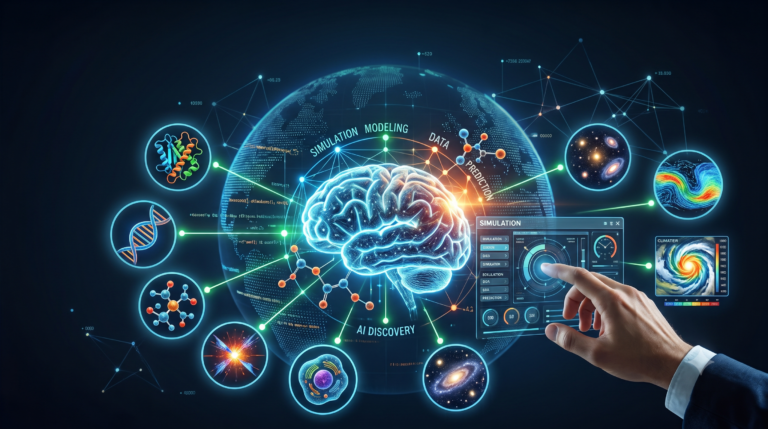
Nature is full of complex systems. The human brain contains billions of neurons communicating with each other. A single cell contains thousands of interacting molecules. Proteins fold into precise three-dimensional structures. Diseases spread through populations. Weather and climate emerge from countless interactions between the atmosphere, oceans and land. Understanding these systems through physical experiments alone can be extremely difficult. Computational Science provides another powerful way to explore them: build mathematical and computational representations of the real world, run experiments inside computers, analyze enormous amounts of data and increasingly use Artificial Intelligence to discover patterns and make predictions.
At its simplest, Computational Science can be described as the use of mathematics, computer science, algorithms, data, simulation and scientific knowledge to model, analyze, predict and understand real-world phenomena. It is not a replacement for traditional science. Instead, it adds another powerful approach alongside theory and experiment. A scientist can develop a theory, translate that understanding into mathematical equations or computational models, run simulations, compare the results with real-world observations and then refine the model. With AI becoming more capable, computers can also learn patterns from scientific data and help researchers explore possibilities that may be difficult to identify manually.
From the Real World to a Computational Model
The fundamental idea behind Computational Science is surprisingly simple. Scientists observe a phenomenon and try to understand the principles behind it. Those principles can be expressed mathematically or represented computationally. Algorithms allow computers to perform enormous numbers of calculations. The resulting simulation produces data that researchers can analyze and compare with experiments or observations. Machine learning can then be used to identify patterns, approximate complex relationships or generate predictions. The process can be repeated to improve the model and test new hypotheses.
Imagine trying to understand how a disease spreads through a city. Researchers can create a computational representation of a population, its contact patterns and the mechanisms of disease transmission. They can then explore different scenarios: what happens if transmission increases, immunity changes or population behavior changes? AI can potentially analyze additional data and identify patterns that traditional models may not capture easily. The computer does not tell us exactly what will happen in the real world, but it provides a powerful environment for exploring possibilities.
Computational Science Is a Broad Scientific Universe
Computational Science is not a single scientific discipline. It is an interdisciplinary approach that can be applied to almost every area of science. When computational methods are applied to the brain, the field becomes Computational Neuroscience. When they are applied to biological systems, we get Computational Biology. When they are used to analyze biological information such as DNA sequences, we enter Bioinformatics and Computational Genomics. Similar approaches produce Computational Chemistry, Computational Physics, Computational Medicine, Computational Epidemiology, Computational Ecology, Computational Materials Science, Computational Earth Science and many other specialized fields.
The scientific domain changes, but the underlying philosophy remains similar: understand a real system, create a computational representation, perform experiments through computation, analyze the results and use the findings to improve our understanding of the system.
Major Areas of Computational Science
Computational Science is not one single field. It connects many scientific disciplines.
🧠 Computational Neuroscience
Computational Neuroscience uses mathematics, simulations, statistics and AI to understand how the brain and nervous system process information. It models neurons, neural networks, brain activity, learning, perception and cognition.
It creates an important connection between neuroscience and artificial intelligence.
🧬 Computational Biology
Computational Biology uses mathematical and computational models to understand biological systems, from genes and proteins to cells, organisms and populations.
It helps researchers study biological processes, disease mechanisms and complex interactions that are difficult to investigate experimentally at scale.
🧬 Bioinformatics & Computational Genomics
Bioinformatics focuses on analyzing large biological datasets such as DNA, RNA and protein sequences.
Computational Genomics applies these methods specifically to genomes, helping researchers identify mutations, genetic patterns and relationships between genes and biological traits.
🧪 Computational Chemistry
Computational Chemistry uses mathematical models and simulations to study molecules, chemical reactions and molecular interactions.
It is widely used in areas such as drug discovery, molecular design and materials research, reducing the need to test every possibility experimentally.
⚛️ Computational Physics
Computational Physics uses numerical methods, algorithms and simulations to study complex physical systems.
It can model everything from fluid flow and materials to particles, quantum systems, stars and galaxies, especially when analytical solutions become difficult.
⚛️ Quantum Physics & Quantum Simulation
Computational methods are increasingly used to model quantum systems and investigate phenomena that are difficult to reproduce experimentally.
Quantum simulation also connects physics with emerging quantum computing technologies.
💻 Quantum Computing
Quantum computing represents a different computational paradigm based on quantum mechanical principles.
It has potential applications in areas such as simulation, optimization, cryptography, and certain scientific problems.
🧱 Computational Materials Science
Uses computation to understand and design materials at atomic, molecular, and larger scales.
It can support research into batteries, semiconductors, catalysts, advanced materials, and other technologies.
🩺 Computational Medicine
Computational Medicine applies computational modeling, statistics, data analysis and AI to understand diseases and healthcare.
It can support medical imaging, disease modeling, drug-response research, precision medicine and analysis of large-scale patient data.
💊 Computational Drug Discovery
Uses computational models, simulations, molecular data, and AI to identify and design potential drug candidates.
It can help researchers explore enormous chemical spaces more efficiently.
🦠 Computational Epidemiology
Uses mathematical and computational models to understand how diseases spread through populations.
These models can help researchers explore transmission patterns, interventions, and possible scenarios.
🌱 Computational Ecology
Uses computation to study ecosystems, species interactions, biodiversity, and environmental changes.
It helps researchers understand complex relationships between organisms and their environments.
🌍 Computational Earth & Climate Science
Uses simulations and data to study Earth’s atmosphere, oceans, land systems, weather, and climate.
Large computational models allow scientists to explore environmental processes across different spatial and time scales.
🌊 Computational Fluid Dynamics
CFD uses mathematics and numerical computation to simulate how liquids and gases move.
It is used to study airflow around aircraft, fluid movement in machines, weather-related processes and many engineering systems without having to physically test every configuration.
🌌 Computational Astrophysics & Cosmology
Uses computational models and simulations to study stars, galaxies, black holes, gravitational systems, and the evolution of the universe.
Some questions require simulations involving enormous numbers of interacting objects.
🏗️ Computational Engineering
Uses computational models and simulations to design, test, and optimize engineering systems.
It allows engineers to experiment virtually before building physical systems.
👥 Computational Social Science
Applies computational methods to understand human behavior, societies, networks, economies, and large-scale social phenomena.
It can combine social science theories with large datasets, simulations, and AI.
The Role of AI in Computational Science
Artificial Intelligence is becoming an increasingly important part of modern Computational Science, helping researchers analyze complex systems, discover patterns, make predictions, and explore possibilities that may be difficult to investigate through traditional methods alone.
However, it is important to understand the relationship correctly:
AI is not Computational Science itself. AI is a powerful computational tool that can extend and enhance scientific research.
Traditional Computational Science often begins with scientific theories, mathematical models, and computational simulations to represent and understand real-world systems.
AI introduces another complementary approach: learning patterns and relationships from data and using them to make predictions or support scientific discovery.
This creates two powerful approaches:
Scientific Knowledge → Mathematical Model → Computational Simulation
and
Scientific Data → AI / Machine Learning → Pattern Discovery → Prediction
Modern research increasingly brings these approaches together:
Scientific Theory + Mathematics + Simulation + Data + AI
This combination is driving the growth of Scientific Machine Learning (SciML), where machine learning is integrated with scientific models, simulations, physical laws, and domain knowledge.
The goal is not simply to replace traditional scientific methods with AI, but to combine the strengths of both approaches—using scientific principles to understand why systems behave the way they do, and AI to help discover what the data may reveal.
This creates a powerful cycle:
Understand → Model → Simulate → Learn → Predict → Validate → Discover
And that is where AI can become a major force multiplier for Computational Science.
AI Can Play Several Different Roles
AI can act as a pattern detector. Scientific datasets can contain millions or billions of observations. Machine learning can identify relationships that would be difficult to discover manually.
AI can act as a predictor. Once trained on appropriate data, models can estimate properties or outcomes for previously unseen cases.
AI can act as a surrogate model. Some scientific simulations are computationally expensive. A machine-learning model can sometimes learn to approximate parts of the simulation much faster, subject to validation and appropriate error analysis.
AI can act as a search and optimization system. Scientific researchers often need to explore enormous spaces of possible molecules, proteins, materials or experimental parameters. AI can help identify promising regions of those spaces.
AI can also act as a generative system. Instead of only predicting what already exists, generative models can propose new molecules, proteins, materials or designs that researchers can investigate experimentally.
This changes the role of computation from simply simulating what exists toward also exploring what could exist.
AlphaFold: A Landmark Example of AI + Computational Biology
One of the most famous examples of AI contributing to Computational Science is protein structure prediction.
Proteins are long chains of amino acids that fold into complex three-dimensional structures. Their structure strongly influences their biological function. Predicting the three-dimensional structure of a protein from its amino-acid sequence was a longstanding scientific challenge.
DeepMind’s AlphaFold demonstrated how deep learning could make major progress on this problem. AlphaFold generated highly accurate structural predictions for many proteins, transforming protein structure prediction and providing researchers with a powerful computational resource.
The broader lesson is important.
A biological question was transformed into a computational problem:
Amino-acid sequence
↓
AI model
↓
Predicted 3D structure
↓
Scientific analysis
↓
Experimental investigation
This illustrates how AI can become part of the scientific discovery pipeline rather than simply being used for conventional software applications.
Genesis and the Rise of Large-Scale Simulation
Another interesting direction is represented by Genesis, a physics simulation platform designed for robotics and embodied AI research. It provides a computational environment for simulating physical worlds and complex interactions.
Its significance illustrates a broader trend: increasingly powerful simulation environments can allow researchers to create virtual worlds in which physical systems, robots and intelligent agents can be studied at scale.
This idea connects Computational Science with AI in an important way.
Instead of training or testing an intelligent system only in the physical world, researchers can create computational environments where millions of experiments can potentially be performed.
The broader pattern is:
Physical World → Computational Simulation → AI Agent → Virtual Experiments → Learning → Physical Validation
This concept is particularly relevant to robotics, autonomous systems and embodied intelligence.
From Simulation to Discovery
Traditional scientific computing often focused on solving equations and simulating known systems.
Modern Computational Science is increasingly moving toward discovery and design.
The progression can be viewed as:
Observe → Model → Simulate → Predict → Discover → Generate → Design → Experiment
Computers can search through enormous spaces of possibilities that would be impossible for humans to explore manually.
This is particularly powerful in areas such as:
Protein design, Drug discovery, Materials discovery, Quantum systems, Climate modeling, Robotics, Engineering optimization, Astrophysics
The computer becomes not just a calculator, but a scientific exploration engine.
The Future of Computational Science
The future of Computational Science is likely to become increasingly interdisciplinary. A researcher studying a biological problem may use mathematics, programming, molecular simulation, genomics, machine learning and laboratory experiments. A physicist may combine quantum theory, numerical simulation and AI. An engineer may combine physics-based simulation, optimization and generative design. A neuroscientist may combine neural recordings, mathematical models and machine learning.
The boundaries between traditional scientific disciplines are becoming increasingly connected through computation. The important skill is therefore not simply knowing one computational tool. It is learning how to move between:
Scientific Question → Mathematical Model → Computational Model → Data → Simulation → AI → Experiment
Conclusion: Computation as a New Scientific Instrument
Computational Science is ultimately about using computation to understand the complexity of nature.
It connects mathematics, science, computer science, data, simulation and AI into one interdisciplinary ecosystem.
From neurons to proteins, molecules to materials, quantum particles to galaxies, diseases to ecosystems, computation gives researchers a new way to explore systems that may be too complex, expensive or difficult to study entirely through physical experiments.
AI is accelerating this transformation by helping researchers analyze massive datasets, identify patterns, make predictions, optimize possibilities and generate new scientific candidates. The direction of scientific research is therefore increasingly moving from:
Observe → Understand → Model → Simulate
toward:
Observe → Model → Simulate → Predict → Discover → Generate → Design → Experiment
It provides a way to investigate complex systems through modeling, simulation, data, and with the growing integration of AI, computation is moving beyond simply helping scientists analyze knowledge toward helping them discover, predict, design, and explore what may be possible next.