
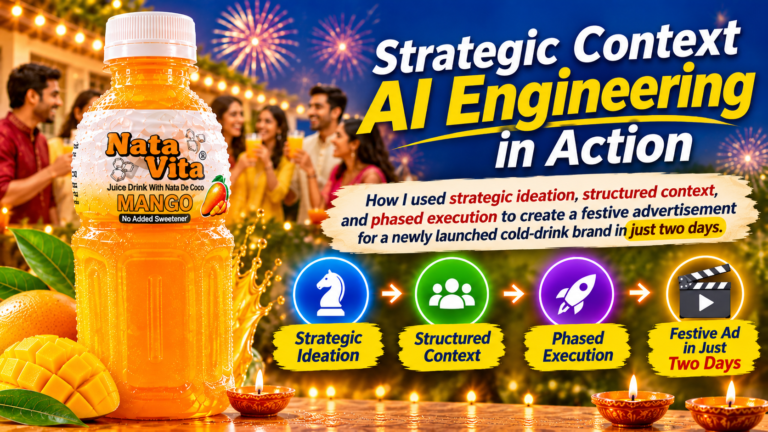
How I used strategic ideation, structured context, and phased execution to create a festive advertisement for a newly launched cold-drink brand in just two days with limited resources.
AI capabilities are evolving rapidly, making it easier than ever to generate videos, images, content, and even complete creative campaigns. But having access to AI capabilities and knowing how to use them effectively are two different things.
Recently, I got an opportunity to explore this difference through a real-world creative project for my cousin’s newly launched cold-drink brand, Nata Vita – Cold Drink with Nata de Coco. What started as a simple request to create an advertisement turned into an interesting experiment in applying my approach to Strategic Context AI Engineering.
Here is how I approached it.
The Challenge: A 30-Second Advertisement in Just Two Days
During my Diwali vacation, while visiting my hometown, I received a call from my cousin brother. He had recently launched his cold-drink brand, Nata Vita, and wanted me to create a creative advertisement video that he could quickly distribute to promote the product.
I had approximately two days to make it happen.
I had access to a Gemini Pro subscription, thanks to the Jio offer, which provided me with video-generation capabilities. However, there were practical limitations.
- Each video generation produced approximately 10 seconds of footage.
- I could generate only around 3–4 videos per day.
- My target was to create an advertisement of at least 30 seconds.
- I had limited time and generation opportunities.
With these constraints, randomly experimenting with different prompts wasn’t a practical approach. I needed to make every generation count.
The Initial Approach: Random Video Generation
Initially, I started generating videos directly using Gemini with basic prompts. Although the generated videos were interesting, I quickly realized that this approach wasn’t giving me the creative direction I wanted.
There were a few challenges:
- I didn’t have a clearly defined storyline.
- Individual video generations weren’t necessarily connected.
- I lacked a clear understanding of how to build a consistent 30-second advertisement.
- Random experimentation could consume my limited generation opportunities.
I realized that the challenge wasn’t simply generating three 10-second videos. The real challenge was creating one meaningful 30-second advertisement using three connected video segments.
That changed my approach. Instead of asking AI to generate videos immediately, I decided to work on the context and strategy first.
Strategic Context: Understand Before You Generate
Before writing any video-generation prompts, I focused on understanding the brand, audience, occasion, and objective.
Since it was Diwali, I saw an opportunity to connect the product with the festive atmosphere. In India, Diwali and the New Year are occasions when friends and family visit each other’s homes, exchange wishes, celebrate together, and create memories. I wanted the advertisement to capture this familiar experience.
Rather than simply showcasing a cold drink, I wanted to position Nata Vita as part of those festive moments.
I used OpenAI to ideate and develop the creative advertisement script around this cultural context. I started by establishing a clear understanding of the brand, its product, the target audience, the festive occasion, and the overall objective. This helped me establish a creative direction before moving into video generation.
I structured the initial requirements around five important elements:
- Brand Context: Nata Vita – a cold drink featuring nata de coco.
- Occasion: Diwali and festive celebrations.
- Target Audience: Friends and families celebrating together.
- Creative Direction: A festive gathering where Nata Vita becomes part of the celebration.
- Objective: Create an engaging, memorable advertisement that introduces the brand and connects it with festive moments.
The important shift was that I wasn’t asking AI to invent everything from scratch. I was providing the strategic context required to develop the right creative direction.
Structured Execution: Divide the Story into Three Phases
Once the storyline was ready, I divided the advertisement into three connected phases of approximately 10 seconds each.
Instead of treating them as three independent video generations, I approached them as three parts of one larger advertisement. Each phase had a specific purpose within the overall storyline.
I prepared a dedicated context and prompt for each phase, describing exactly what should happen in the scene, who the characters were, what they were doing, the environment, the festive atmosphere, camera movements, visual direction, and how the product should appear.
- Scene: What exactly should happen during those 10 seconds?
- Characters: Who is involved, and what are they doing?
- Environment: What should the location and festive atmosphere look like?
- Visual Direction: Camera movements, framing, and cinematic elements.
- Product Placement: How should Nata Vita appear in the scene?
- Continuity: How should this scene connect with the previous and next phases?
I also considered how each scene should connect with the previous and following phases. The objective was to maintain a consistent creative direction rather than generate three unrelated videos.
This helped me move from generic prompting to structured, context-driven execution. Every prompt had a specific purpose, but all three were guided by the same creative vision.
Strategic AI Utilization: The Right Tool for the Right Task
With the storyline, context, and prompts ready, I moved to video generation using Gemini.
My execution strategy was straightforward: generate the first 10-second phase, build upon the previous video for the second phase, and continue the sequence for the third phase. By progressively extending the video, I worked towards a connected 30-second advertisement.
I used OpenAI for creative ideation and context structuring, while Gemini handled video generation. Rather than expecting a single AI model to handle the entire process, I utilized different AI capabilities for different tasks.
This is another important aspect of strategic AI utilization: understanding what each tool can contribute best and organizing the workflow accordingly.
The result was a 30-second festive advertisement built around one consistent storyline.
Random AI Generation vs. Strategic Context AI Engineering
This experiment highlighted the difference between simply using AI and strategically engineering the context around it.
With random AI generation, we often start generating immediately, experiment with different prompts, and focus on individual outputs. This can lead to disconnected results and unnecessary iterations, especially when the objective isn’t clearly defined.
With Strategic Context AI Engineering, the process starts by understanding the problem and defining the desired outcome. We establish the relevant context, develop a clear direction, break the task into manageable phases, and structure prompts around the requirements of each phase.
Instead of reacting to every individual generation, we plan the execution around the final outcome.
The difference isn’t necessarily the AI model, subscription, or technology. It’s the thinking, preparation, and strategy behind how we use AI.
What This Experiment Reinforced
There are five important takeaways from this experience.
1. Context Comes Before Prompting : A good prompt starts with a good understanding of the problem. The clearer the objective, audience, requirements, and expectations, the better we can guide AI towards the desired outcome.
2. Structure Complex Tasks into Smaller Phases: Instead of approaching a larger outcome as one difficult task, divide it into smaller, manageable phases. Each phase should have a clear purpose while contributing to the overall objective.
3. Use Different AI Models Strategically: You don’t necessarily need one AI model to handle everything. Use different tools based on their capabilities and the requirements of each task.
4. Optimize Resources Alongside Results: Time, credits, subscriptions, and budgets are practical constraints. Strategic planning helps reduce unnecessary experimentation and makes better use of available resources.
5. Focus on the Actual Problem, Not Just AI Capabilities: My objective wasn’t to generate impressive AI videos. It was to help a newly launched business promote its product through a creative advertisement.
AI was the means to achieve that objective, not the objective itself.
Beyond Software Engineering: Where Can Strategic Context AI Be Applied?
I’ve been exploring Strategic Context AI Engineering as an approach to improve AI-generated outcomes through strategic problem understanding, structured requirements, relevant context, modular execution, and effective utilization of AI models.
This experiment demonstrated how the same thinking can be applied outside software engineering.
Consider some other applications:
- Marketing: Creating advertisements, campaigns, and brand communication.
- Business: Researching opportunities, developing strategies, and solving operational problems.
- Design: Developing creative concepts, presentations, and product experiences.
- Research: Structuring information, exploring ideas, and developing meaningful insights.
- Software Engineering: Defining requirements, designing architecture, generating code, and validating outcomes.
The tools and execution methods may change, but the underlying principle remains similar.
Before asking AI to perform a task, understand what you want to achieve, identify the context it needs, structure the work, and then utilize AI strategically.
Final Thoughts
AI capabilities are advancing rapidly. New models and tools are making things possible that were difficult or expensive to achieve just a few years ago. However, access to powerful AI doesn’t automatically translate into meaningful outcomes.
We still need to understand the problem, define the objective, provide relevant context, and make thoughtful decisions about how to use those capabilities.
My Nata Vita advertisement experiment was a small example of this approach in action. I had two days, limited video-generation opportunities, and a 30-second creative objective. Instead of relying on random experimentation, I used strategic ideation, structured context, and phased execution to work towards the desired result.
One important realization from this experiment is that when resources are limited, we sometimes need to accept small compromises in accuracy, visual consistency, or execution. AI-generated outputs may not perfectly match every expectation, and achieving perfection may require more iterations, time, and resources.
However, a strategically planned approach can still deliver a more relevant, consistent, and accurate outcome than repeatedly generating random results without a clear direction. The objective is not always perfection; it is to make the best possible use of the resources available while staying focused on the desired outcome.
There is an interesting connection here with The Art of War by Sun Tzu. One of its central lessons is the importance of strategy, preparation, and planning before taking action. In the context of AI, I would put it this way:
One well-planned strategy can be more effective than 50 random attacks.
Similarly, generating 50 random prompts doesn’t necessarily produce a better outcome than developing one clear strategy, engineering the right context, and executing it thoughtfully.
AI gives us capabilities, but strategy determines how effectively we use them.
You don’t always need more AI resources to achieve better results. Sometimes, you need a better strategy to use the resources you already have.
And that’s the idea behind Strategic Context AI Engineering: Don’t just prompt AI. Strategically engineer the context around it.