

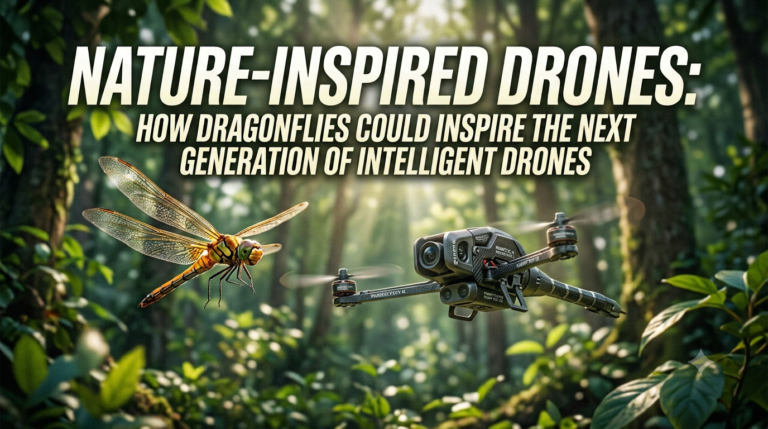
What 300 million years of evolution can teach us about adaptive, resilient and intelligent flight
For millions of years, nature has been solving engineering problems that humans are still trying to understand. Flight is one of the most remarkable examples. Long before humans built aircraft, drones or autonomous robots, insects had already evolved sophisticated ways to generate lift, maneuver through turbulent environments, avoid obstacles and respond to rapidly changing conditions.
Among these natural flyers, the dragonfly is particularly fascinating. Its ability to hover, accelerate, turn sharply, fly backward and remain stable in changing airflow makes it more than an interesting insect. It can be viewed as a biological example of a highly integrated flight system in which wings, muscles, sensory mechanisms and nervous-system control work together.
This is where biomimicry becomes interesting. The goal is not simply to build a drone that looks like a dragonfly. The deeper opportunity is to understand the principles behind its flight and translate those principles into engineering.
The question is therefore not “How can we build a dragonfly?”
It is:
“What can the dragonfly teach us about building drones that can adapt, recover and intelligently respond to the world around them?”
From Biomimicry to Bio-Inspired Intelligence
Traditional drone design often separates the aircraft into recognizable engineering components: motors generate thrust, propellers generate lift, sensors collect information and software controls the system.
Nature does not necessarily work this way.
In a dragonfly, the body, wings, muscles, sensory systems and nervous system continuously interact. The physical structure of the animal itself contributes to how it senses and responds to its environment.
This suggests a different way of thinking about drone architecture.
Instead of designing a machine that simply receives information → computes a response → moves, we could design machines in which the structure itself participates in sensing, adaptation and control.
That shift could take biomimicry from copying biological shapes to copying biological principles of intelligence.
Rethinking the Architecture of a Drone
One of the most interesting characteristics of dragonfly flight is its four-wing configuration.
Unlike a conventional quadcopter, where four propellers are generally coordinated through motor-speed changes, a dragonfly has two pairs of wings whose movements can be coordinated in different ways.
The wings can interact aerodynamically, producing different forces depending on their timing, movement and relationship with the surrounding airflow.
For drone engineers, this raises an important possibility: could future aerial robots use multiple independently controlled aerodynamic surfaces to achieve more adaptive flight?
Such a system could potentially change its wing movement depending on whether it is hovering, accelerating, turning, navigating turbulence or recovering from a disturbance.
The drone would not simply have one flight configuration.
It could continuously change how it flies.
When Flexibility Becomes a Feature
Modern aircraft often attempt to make structures rigid because predictable geometry makes control easier.
Dragonfly wings demonstrate another strategy.
Their wings combine a lightweight membrane with a complex network of veins. The resulting structure provides strength while still allowing deformation during flight.
That deformation is not necessarily a defect.
It can influence the aerodynamic forces generated by the wing.
This creates an interesting engineering opportunity: instead of treating deformation as something a drone must eliminate, future drones could potentially use controlled deformation as part of their flight system.
Imagine a wing that can subtly change its shape in response to airflow.
Instead of relying entirely on motors and conventional control surfaces, the physical structure itself could become part of the control mechanism.
This could lead to morphing wings that continuously adapt to different flight conditions.
The Wing as a Sensor
Perhaps one of the most powerful lessons from biological flight is that the structure of an organism can also provide information about its environment.
A flexible wing experiences forces and deformation while flying. Those changes contain information about the surrounding aerodynamic conditions.
Engineers could potentially translate this principle into smart wings containing distributed sensing elements capable of detecting strain, vibration, deformation or aerodynamic loading.
The wing would then serve multiple purposes simultaneously.
It would generate aerodynamic forces, experience those forces, measure changes in its physical state and provide information to the control system.
This creates a fascinating concept:
What if a drone could sense the world through the way its own body moves?
That is very different from depending entirely on external cameras, GPS or conventional environmental sensors.
From Fighting the Wind to Understanding the Wind
Wind and turbulence are major challenges for small aerial vehicles.
A conventional control system attempts to detect disturbances and compensate for them.
A dragonfly-inspired system could take this idea further.
If a drone continuously sensed changes in wing deformation, vibration and aerodynamic loading, those signals could potentially provide an immediate indication that the surrounding airflow has changed.
The control system could then modify wing motion before instability becomes severe.
Instead of simply fighting turbulence, the drone could learn to adapt to turbulence.
This distinction could become increasingly important for autonomous drones operating around buildings, forests, bridges, mountains or disaster zones, where airflow can change rapidly and unpredictably.
Designing for Failure Instead of Assuming Perfection
Most engineered systems are designed around the assumption that critical components should not fail.
Biological systems offer another lesson: sometimes survival depends not on preventing every failure, but on remaining functional after failure.
A dragonfly does not represent an engineering system where every component must remain perfectly intact forever. Biological organisms operate in environments involving collisions, damage, changing conditions and uncertainty.
This inspires the idea of fault-tolerant drones.
What if a drone could detect that one wing, actuator or control surface was damaged and automatically redistribute control authority across its remaining components?
Instead of immediately becoming uncontrollable, it could change its flight strategy.
That could be particularly valuable in environments where drones cannot simply land and wait for maintenance.
The Possibility of Self-Recovering Drones
A future drone could potentially have a hierarchy of responses.
First, it could attempt to avoid a disturbance.
If avoidance fails, it could absorb or tolerate the disturbance.
If damage occurs, it could detect the change.
Then it could reconfigure its control strategy and attempt to continue flying.
This creates a fundamentally different design philosophy:
Avoid → Sense → Adapt → Recover.
Such a system could be valuable for search-and-rescue missions, infrastructure inspection and disaster environments where reliability is more important than perfect operating conditions.
Collision-Tolerant Flight
Small drones frequently operate close to physical objects.
Indoor inspection, warehouse navigation, forest monitoring and infrastructure inspection can involve narrow spaces and unexpected obstacles.
Conventional drone designs often depend heavily on precise sensing and rapid obstacle avoidance.
Dragonfly-inspired design suggests another possibility: make the machine more tolerant of contact.
Flexible structures, compliant components and energy-absorbing mechanisms could allow a drone to survive minor collisions rather than treating every contact as catastrophic.
The goal would not be to replace obstacle avoidance.
It would be to create a second layer of resilience:
Avoid the obstacle when possible. Survive the collision when necessary.
The Rise of Micro-Aerial Robots
Dragonflies also provide inspiration for another important direction: extremely small flying robots.
Reducing the size of a drone creates difficult engineering problems. Smaller vehicles have different aerodynamic characteristics, limited energy capacity and less room for conventional sensors and actuators.
Biological flyers operate successfully at these scales because their entire flight system has evolved around the constraints of small size.
This could inspire new generations of micro-aerial vehicles designed for environments where conventional drones are too large.
Potential applications could include indoor inspection, confined-space exploration, environmental sensing and disaster-response robotics.
From Fixed Flight Modes to Continuous Adaptation
Many autonomous systems are designed around predefined flight modes: takeoff, hover, cruise, turn and landing.
Biological flight is more continuous.
A dragonfly can transition between different movements while continuously adjusting its wings and body.
This suggests another opportunity for drone control systems: rather than switching between rigidly defined modes, a drone could continuously adjust its configuration according to its current environment.
Its flight strategy could depend on airflow, payload, battery level, obstacles, mission objectives and structural condition.
This moves the concept of autonomy from following predefined commands toward continuous adaptation.
Morphological Intelligence
This leads to a deeper concept known as morphological intelligence.
In conventional robotics, intelligence is often associated primarily with computation: processors, algorithms and artificial intelligence models.
But biological organisms demonstrate that physical structure can also contribute to intelligent behavior.
The shape, flexibility and mechanical properties of a body can simplify sensing and control.
For drones, this could mean designing the physical body so that some environmental changes naturally produce useful responses.
Instead of asking AI to solve every problem computationally, engineers could design the machine so that its physical structure helps solve part of the problem.
This could reduce computational requirements while potentially increasing robustness.
From Artificial Intelligence to Embodied Intelligence
The next step is embodied intelligence.
A truly adaptive drone would not treat its body, sensors, software and environment as completely separate systems.
Its intelligence would emerge from their interaction.
The wings would sense forces.
The sensors would interpret changes.
The control system would modify wing behavior.
The physical response would change the aerodynamic environment.
The sensors would then observe the new state.
This creates a continuous feedback loop between body → environment → perception → decision → action → body.
That is much closer to how biological systems operate.
From One Drone to an Intelligent Swarm
Dragonfly-inspired principles could eventually extend beyond individual drones.
Imagine hundreds of small autonomous aerial robots, each capable of adapting to its environment and continuing to operate even when individual units fail.
Instead of building one extremely complex and expensive drone, engineers could distribute sensing, computation and mission responsibilities across many smaller machines.
The biological inspiration here is not only the dragonfly itself but the broader principle of distributed intelligence found throughout nature.
A swarm could potentially explore large areas, share environmental information and reorganize itself when individual members become unavailable.
Where Could This Technology Go?
The most interesting applications may appear in environments where conventional drones struggle.
A dragonfly-inspired drone could potentially inspect bridges and power infrastructure while adapting to turbulent airflow. It could enter damaged buildings after disasters and navigate confined spaces. It could monitor forests and agricultural environments while responding dynamically to changing wind conditions.
In healthcare or emergency-response scenarios, extremely small aerial robots could potentially explore environments that are difficult or unsafe for humans.
In industrial environments, resilient drones could inspect machinery, tunnels, pipelines and other infrastructure where collisions or sudden airflow changes are possible.
The important point is that these applications would not require a drone to literally become a dragonfly.
They would require engineers to translate biological principles into useful engineering mechanisms.
The Real Innovation Is Not Building a Dragonfly
This is perhaps the most important lesson of biomimicry.
Copying nature’s appearance is relatively easy.
Understanding why nature works is much harder.
A dragonfly-inspired drone does not necessarily need four wings that look like a dragonfly’s wings. The deeper inspiration could come from independent actuation, flexible structures, distributed sensing, adaptive control, fault tolerance and embodied intelligence.
This is the difference between biological imitation and biological inspiration.
The first asks:
“What does the dragonfly look like?”
The second asks:
“What problem has evolution solved, what principle makes that solution work, and how can we translate that principle into technology?”
That question opens a much larger innovation space.
The Dragonfly as a Blueprint for the Future
For more than 300 million years, dragonflies have existed in changing environments, continuously adapting their flight to airflow, movement, obstacles and biological demands.
Human drone technology is comparatively young.
The next generation of drones may therefore not be defined simply by faster processors, stronger motors or larger batteries. The bigger breakthrough could come from creating machines that are adaptive by design.
Machines whose wings can change.
Machines that sense through their own structure.
Machines that respond to turbulence rather than simply resist it.
Machines that can tolerate damage and reorganize their behavior.
Machines whose physical bodies participate in their intelligence.
And perhaps, eventually, machines that work together as distributed aerial ecosystems.
The future of autonomous flight may not be about making drones more powerful versions of today’s machines.
It may be about making them more alive in the way they respond to uncertainty.
That is the deeper promise of biomimicry.
Nature does not give us finished technologies. It gives us principles.
And the dragonfly may be offering one of the most fascinating principles of all:
Intelligent flight is not just about controlling a machine. It is about designing a machine that can continuously adapt itself to the world it is flying through.