

Every successful product begins with a problem worth solving. People do not simply buy products because they exist; they choose products that help them accomplish something, overcome a frustration, save time, feel more confident, or improve their everyday lives.
Consider the smartwatch. What began largely as an extension of the smartphone has evolved into a device that can help people track physical activity, understand sleep patterns, receive notifications, and access health-related insights. But building a successful smartwatch involves much more than adding sensors, developing software, or creating an attractive design. It requires understanding customer needs, identifying the right opportunity, validating assumptions, making thoughtful design decisions, testing performance, and continuously improving the product.
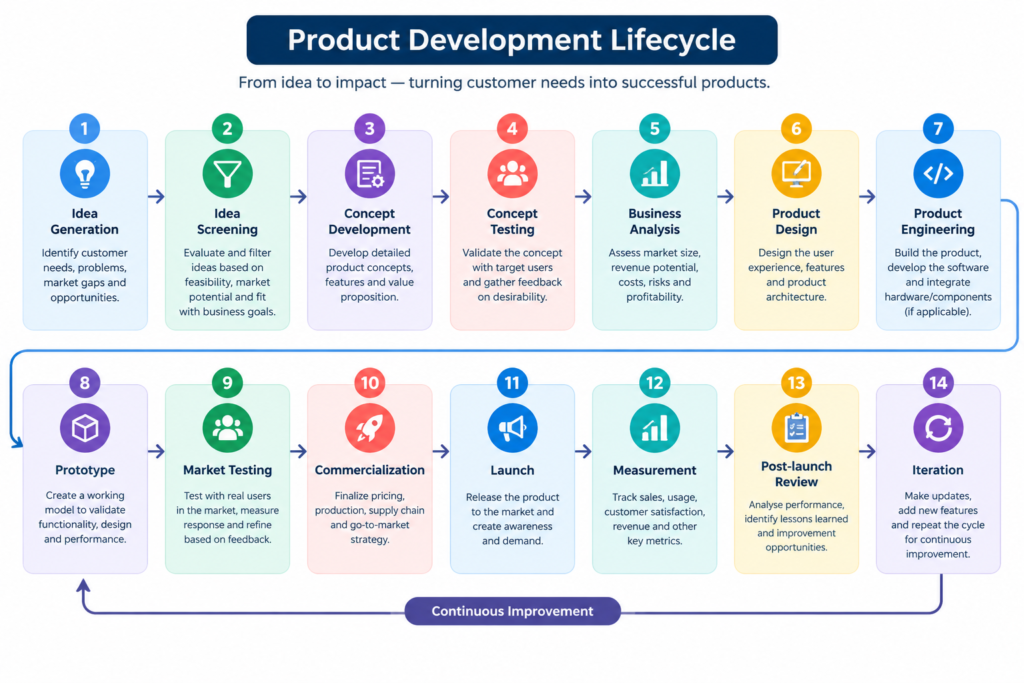
This is where the Product Development Lifecycle becomes essential. It provides a structured approach to transforming customer problems and market opportunities into products that deliver meaningful user value and sustainable business results.
Whether you are developing a smartwatch, wireless earbuds, a digital service, or an entirely new product, understanding this lifecycle can help you reduce uncertainty, make better decisions, and build products people genuinely want to use.
1. Identify Customer Problems and Unmet Needs
Product development should begin with understanding people, not immediately deciding what to build. Customers experience frustrations, limitations, and unmet needs in their everyday lives, but they may not always be able to articulate the solutions they want. The first step is to discover these problems by observing behaviour, listening to customers, analysing feedback, and examining how people currently accomplish their goals.
Consider people who want to improve their health and daily activity. Some struggle to maintain consistent exercise habits, while others want to understand their sleep patterns or monitor their daily movement. People may also find it inconvenient to repeatedly reach for their smartphones to check notifications. These are different customer problems, and each could lead to a different product opportunity.
Research might reveal that the underlying need is not simply to count steps. Customers may want a convenient way to understand their daily habits, stay motivated, or make more informed decisions about their well-being. Identifying the underlying need helps product teams avoid building features that look impressive but fail to solve meaningful problems.
The goal is to understand the gap between what customers experience today and what they would like to achieve.
2. Research the Market and Evaluate the Opportunity
Once potential customer problems have been identified, the next step is to understand the market surrounding them. A problem may be genuine, but that does not automatically mean there is a viable business opportunity. Product teams must evaluate the size of the target market, existing alternatives, customer expectations, competitive offerings, technological developments, and willingness to pay.
In the smartwatch market, customers can choose from products positioned around fitness, everyday convenience, advanced health-related features, premium design, or outdoor activities. Researching these alternatives helps identify where existing products perform well and where customers remain dissatisfied.
For example, research might reveal that some customers want reliable fitness tracking without paying for premium features they rarely use. Another segment might prioritise battery life, while others care more about comfort, compatibility, or a straightforward interface.
These findings help the team decide which customer segment to serve and what opportunity deserves further investigation. Market research should combine quantitative evidence, such as market size and purchase patterns, with qualitative insights into customer motivations and frustrations.
The objective is not to create a product for everyone. It is to identify a worthwhile opportunity for a clearly defined group of customers.
3. Define the Target Customer and Value Proposition
A product cannot effectively solve every problem for every person. After evaluating the market opportunity, the team needs to define its target customers and clarify why the proposed product should matter to them.
A target customer profile goes beyond basic demographics. It considers the person’s goals, behaviours, circumstances, frustrations, purchasing motivations, and expectations. Understanding these factors helps product teams make more relevant decisions about functionality, design, pricing, and communication.
Imagine developing a smartwatch for people who are beginning their fitness journey. These customers might not need an overwhelming collection of advanced metrics. They may value simple activity goals, understandable progress summaries, gentle reminders, comfortable wear, and a clear indication of whether they are becoming more consistent.
The value proposition could therefore focus on making everyday fitness easier to understand and maintain. A smartwatch designed for experienced athletes might require a different proposition, emphasising specialised training metrics, performance analysis, and durability.
A strong value proposition answers three fundamental questions: Who is the product for? What important problem does it solve? Why should customers choose it over the alternatives?
This clarity becomes the foundation for subsequent product decisions.
4. Generate Ideas and Explore Potential Solutions
With the customer problem and target segment clearly defined, the team can explore different ways to solve the problem. Idea generation should encourage multiple possibilities before the team commits to one solution.
For the smartwatch, potential solutions might include personalised activity goals, simplified progress dashboards, reminders based on inactivity, better sleep summaries, improved battery management, or a more accessible interface for first-time users.
At this stage, the team should avoid assuming that the most technologically advanced idea is automatically the best one. A complex feature may increase development costs, consume more battery, or make the product harder to understand. A simpler solution may deliver greater value if it addresses the customer’s primary need more effectively.
Cross-functional collaboration is particularly useful here. Designers can explore interaction and form, engineers can assess technical possibilities, researchers can contribute customer insights, and business teams can evaluate commercial potential.
The team can use brainstorming, concept sketches, storyboards, design workshops, and competitor analysis to generate and compare ideas. The purpose is to explore different solutions without prematurely narrowing the possibilities.
Innovation is not simply about adding something new. It is about finding a better way to solve a meaningful problem.
5. Evaluate Ideas and Select the Most Promising Concept
Not every promising idea should become a product. Before investing significant time and money, the team must assess which concepts offer the strongest combination of customer value, technical feasibility, and business viability.
For a smartwatch, an idea such as improving the clarity of daily activity summaries may offer substantial value with relatively manageable development effort. A new advanced sensing capability, on the other hand, might require specialised hardware, extensive validation, additional power consumption, and greater investment.
The team can compare concepts against criteria such as customer desirability, technical feasibility, cost, competitive differentiation, usability, risk, and revenue potential. Frameworks such as desirability, feasibility, and viability can help structure this evaluation.
Early prototypes, customer interviews, landing-page experiments, and concept tests can provide evidence about whether customers understand and value a proposed solution. The team should also identify assumptions that could invalidate the opportunity, such as customers being unwilling to pay the expected price or the technology failing to meet performance requirements.
The selected concept should represent a reasoned decision supported by evidence, not simply the idea that receives the most enthusiasm in a meeting.
6. Define Product Requirements and Success Metrics
Once a concept has been selected, it must be translated into clear product requirements. These requirements explain what the product needs to do, how well it should perform, and which constraints must be satisfied.
For a smartwatch, requirements might include battery endurance, display readability, comfortable wear, device compatibility, sensor performance, water resistance, data security, and ease of navigation. The team should distinguish essential requirements from desirable enhancements so that development remains focused on the customer’s most important needs.
Requirements should be specific enough to guide design and engineering decisions. For example, instead of stating that the smartwatch should have a good battery life, the team should establish a measurable battery target under clearly defined usage conditions. Instead of saying that the interface should be easy to use, the team could define usability tasks and measure how successfully first-time users complete them.
Success metrics should connect product performance to customer outcomes and business objectives. Depending on the product, these might include successful task completion, customer satisfaction, activation rate, repeat usage, return rate, reliability, production cost, and profitability.
Health-related features require additional care. The team must define what the product can reliably measure, communicate limitations clearly, protect sensitive data, and avoid making medical claims that have not been appropriately validated.
Clear requirements help teams align their work and evaluate whether the final product actually meets its intended purpose.
7. Design the Product Experience
Product design involves much more than creating an attractive exterior. It encompasses the complete experience of using a product, including its physical form, interactions, information architecture, accessibility, feedback, and emotional impact.
For a smartwatch, the experience begins before the first notification appears. Customers must choose a size, wear the device comfortably, pair it with a phone, understand its permissions, configure their preferences, and learn how to interpret the information it provides.
If the display is difficult to read, the controls are confusing, or important information is buried under multiple screens, technically impressive capabilities may become frustrating to use. Conversely, thoughtful design can make complex information easier to understand and everyday tasks more convenient.
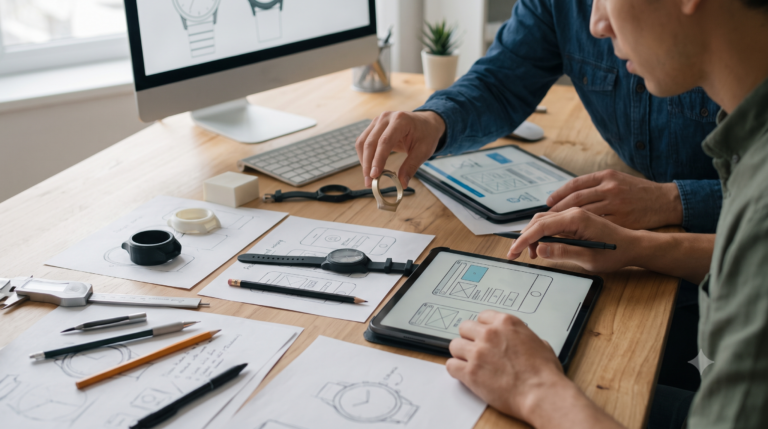
Design teams can use sketches, wireframes, interface prototypes, physical mock-ups, and journey maps to explore these experiences. They should also consider different wrist sizes, visual accessibility, language, cultural expectations, and the needs of people who may not be technologically confident.
Good design balances appearance with usability, comfort, reliability, accessibility, and practicality. It also makes appropriate trade-offs. A larger display might improve readability but affect comfort and battery consumption. More information might increase functionality but create visual clutter.
The objective is to create a product that works well in the customer’s real life, not just in a presentation or demonstration.
8. Build a Prototype and Test Assumptions Early
A prototype makes an idea tangible enough to evaluate. It can range from a simple paper interface to a simulated application, a physical mock-up, or a functioning hardware prototype. The right level of detail depends on the uncertainty the team wants to investigate.
For a smartwatch, an early prototype might simulate the activity dashboard and allow users to navigate between screens. This can reveal whether people understand the information, recognise the next action, and find the interface convenient. A later prototype might include real sensors, battery components, wireless connectivity, and working software.
Testing should focus on specific questions. Can a first-time user complete setup without assistance? Can someone interpret a daily activity summary quickly? Does the watch remain comfortable during normal movement? Does the proposed battery design support the intended usage pattern?
Prototypes help uncover problems before they become expensive to fix. They also allow teams to compare alternatives instead of relying entirely on opinions or assumptions.
Importantly, early prototypes do not need to look finished. Their value lies in generating useful evidence. A rough prototype that reveals a major usability issue can be more valuable than a polished demonstration that hides the underlying problem.
9. Develop and Integrate the Product
After the concept and key assumptions have been validated sufficiently, the team can move into more complete product development. This is where engineering, industrial design, software development, manufacturing, and other disciplines work together to turn the concept into a functioning product.
A smartwatch combines multiple interconnected systems: sensors, processors, a display, a battery, wireless communication, operating software, applications, and potentially cloud-based services. These components must work together reliably within constraints involving size, weight, power consumption, cost, and performance.
A feature that works in isolation may behave differently when integrated into the complete device. Continuous health-related measurements, for example, can affect battery life. Adding a brighter display can influence power consumption. New software features may increase complexity or introduce performance issues.
Teams therefore need to coordinate hardware and software development, manage dependencies, evaluate suppliers, maintain quality standards, and address risks throughout implementation. Security, privacy, accessibility, manufacturing feasibility, and regulatory requirements should be considered during development rather than left until the end.
The development process should remain connected to the original customer problem. A product can be technically sophisticated and still fail if the team loses sight of why the customer needs it.
10. Validate Quality, Performance, Safety, and Usability
Before launch, the product must undergo systematic validation to determine whether it meets its requirements and performs reliably under realistic conditions.
For a smartwatch, testing might cover battery performance, display durability, connectivity, software stability, sensor consistency, water resistance, comfort, and compatibility with supported devices. Usability testing should examine whether customers can complete important tasks without confusion, while reliability testing should help identify failures that might emerge through repeated use.
Testing should include realistic usage patterns rather than relying exclusively on controlled laboratory conditions. People wear devices in different environments, move in different ways, use different phones, and have different expectations. These variations can expose issues that were not apparent during development.
Health-related measurements require particular attention because accuracy and interpretation matter. Teams should validate claims against appropriate reference methods and clearly distinguish wellness information from clinically validated measurements or diagnostic capabilities. Relevant privacy, security, and regulatory obligations must also be satisfied.
When a test identifies a problem, the team should determine its root cause, make the necessary changes, and repeat the relevant tests. Passing one test does not guarantee that every aspect of the product is ready.
The purpose of validation is to establish confidence that the product is safe for its intended use, reliable enough for customers, and ready to deliver the promised experience.
11. Launch the Product and Drive Customer Adoption
A product is not successful simply because it has been developed and released. Customers must understand its value, be able to access it, feel confident purchasing it, and experience enough benefit to continue using it.
Launching a smartwatch therefore involves more than announcing its specifications. The team must establish pricing, distribution, positioning, retail and online availability, product demonstrations, customer support, onboarding, and communication. Marketing should explain how the product helps people rather than relying only on technical feature lists.
For example, a message focused on helping beginners build more consistent activity habits may be more relevant to that audience than a long list of sensor specifications. Demonstrating how a customer can understand daily progress may communicate the benefit more clearly than simply stating that the watch tracks activity.
The launch should also prepare the organisation for the customer experience after purchase. Customers may need assistance with pairing, permissions, compatibility, charging, troubleshooting, or interpreting product information. Clear guidance and responsive support can reduce frustration and improve adoption.
Teams should monitor early indicators such as sales, activation, setup completion, customer feedback, product returns, support requests, and early retention. These signals help identify whether the product is reaching the intended audience and delivering the expected value.
A launch introduces the product to the market; customer adoption determines whether it becomes useful in everyday life.
12. Measure Results, Learn, and Continuously Improve
The Product Development Lifecycle does not end at launch. Customer behaviour, technology, market expectations, and competitive conditions continue to change. Successful product teams use real-world evidence to understand what is working, identify new problems, and decide what to improve next.
For a smartwatch, post-launch learning might reveal that customers appreciate activity tracking but rarely use a complicated dashboard. Feedback might indicate that battery life is more important than a particular advanced feature, or that customers need clearer explanations of sleep insights. Support requests and product reviews may uncover setup problems that were missed during testing.
The team can combine product analytics, customer interviews, reviews, support data, return reasons, and market performance to prioritise improvements. These improvements might involve software updates, simpler navigation, better battery management, more useful summaries, improved accessibility, or changes to future hardware designs.
Not every request should automatically become a new feature. Teams must determine whether the feedback reflects a widespread problem, a critical issue affecting a smaller group, or an isolated preference. Prioritisation should consider customer impact, business value, effort, risk, and alignment with the product strategy.
The team should then measure whether the changes actually improve outcomes. If a new dashboard increases engagement but makes information harder to understand, the apparent improvement may come at the expense of the overall experience.
Continuous improvement creates a learning loop: observe customer behaviour, identify an opportunity, develop a change, test its impact, and refine the product again. Each cycle helps the team make better decisions about what to build next.
Conclusion: Build Products Around People, Not Just Features
The Product Development Lifecycle provides a practical way to move from an identified customer problem to a product that delivers measurable value. From understanding unmet needs and evaluating market opportunities to designing, prototyping, developing, validating, launching, and improving the product, every stage contributes to reducing uncertainty and increasing the likelihood of success.
The smartwatch example demonstrates why these stages must work together. Understanding the customer determines which problem deserves attention. Market research establishes whether an opportunity is worth pursuing. Design makes the experience useful and accessible. Engineering turns the concept into a working product. Testing establishes whether it performs as intended, while customer feedback reveals how it can improve after launch.
These stages are presented in a sequence for clarity, but real product development is rarely perfectly linear. Research may uncover a different customer need, testing may require a design change, or market feedback may lead the team to revisit its original assumptions. Iteration is a natural part of the process.
Ultimately, successful product development is not about creating the largest number of features or adopting the newest technology. It is about understanding people deeply, making evidence-based decisions, balancing customer needs with technical and commercial realities, and continuously improving the value a product delivers.
The best products are not simply built to work. They are built to solve the right problems, fit into people’s lives, and make a meaningful difference.