

Every successful product begins with an opportunity, but not every opportunity becomes a successful product. Some ideas solve problems that customers do not consider important. Others address genuine needs but fail because of poor business models, weak market positioning, ineffective execution, or low adoption.
The real challenge of product development is not simply to generate ideas or design something innovative. It is to identify meaningful problems, recognise market opportunities, validate potential solutions, build products that customers value, and turn those products into sustainable business outcomes.
This is where New Product Development (NPD) plays a critical role. NPD provides a structured, end-to-end process for transforming unsolved problems and market gaps into products that meet customer needs, create business value, and compete successfully in the market.
What Is New Product Development (NPD)?
New Product Development is the systematic process of identifying opportunities, generating and evaluating ideas, developing product concepts, assessing business feasibility, building solutions, testing them in the market, launching them, and evaluating their performance after launch.
NPD applies to entirely new products, improvements to existing products, new product lines, and adaptations of products for new customer segments or markets.
Its purpose extends beyond creating a product that works. It seeks to establish a strong connection between customer desirability, technical feasibility, and business viability. A product must address a real customer need, be possible to develop and deliver, and have a credible path to creating sustainable business value.
Consider an ambitious healthcare innovation: a next-generation smart health watch designed to provide a comprehensive view of the human body’s health through advanced sensors and AI-powered health intelligence.
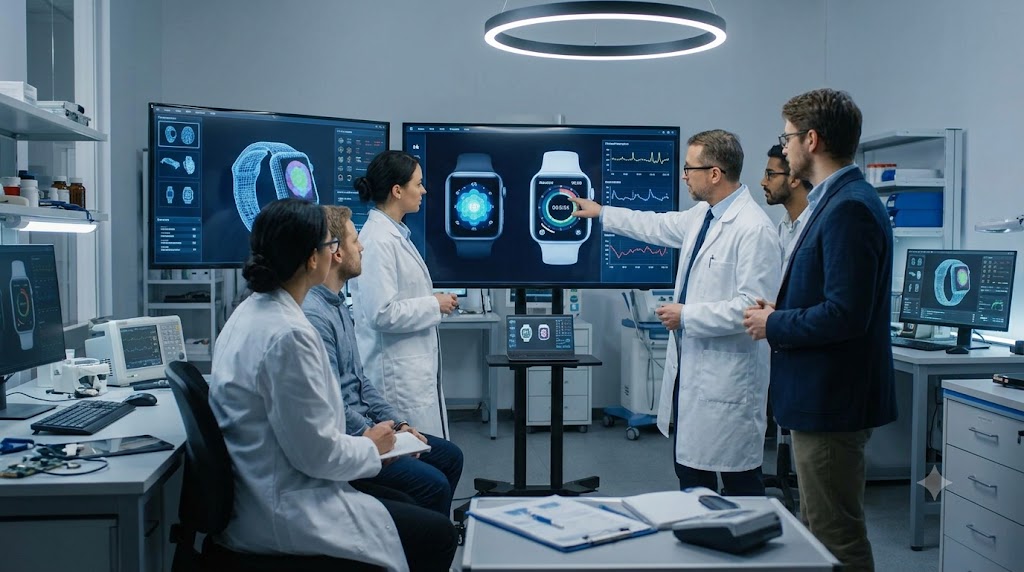
Today, people rely on laboratory blood tests, medical examinations, and multiple devices to understand different aspects of their health. Existing smartwatches can track selected indicators, such as heart rate, sleep, and physical activity, but they cannot provide a complete picture of the body’s health.
This creates an opportunity to imagine a healthcare watch that combines advanced physiological monitoring with emerging biochemical sensing technologies. In the future, it could potentially measure selected biomarkers, provide deeper insights into metabolic health, monitor heart activity, and bring multiple health indicators together in one personalized dashboard.
An AI-powered health intelligence system could analyse these measurements over time, identify meaningful patterns, explain potential concerns, and help users make informed decisions about their health. The ultimate vision is to move beyond tracking individual metrics towards a personal health intelligence system on the wrist.
The NPD journey begins by understanding people’s healthcare needs and identifying which capabilities would deliver the greatest value. Scientists, clinicians, designers, and engineers then explore the feasibility of advanced sensors, biochemical measurements, AI models, and wearable hardware. The team develops prototypes, validates accuracy and safety, evaluates costs and market demand, tests the product, and prepares it for commercialization. Customer feedback and real-world performance guide continuous improvement.

Achieving comprehensive health monitoring would require substantial scientific advances. Current smartwatches cannot replace all laboratory blood tests or diagnose every medical condition, so future capabilities would require rigorous scientific validation and appropriate regulatory approval.
The result would not simply be a watch with more sensors, but a product designed to help people understand their health more comprehensively while creating meaningful customer and business value.
This illustrates the central purpose of NPD: to transform a promising opportunity into a product that creates real value for customers and sustainable value for the business.
Why Do We Need NPD?
Organisations constantly encounter customer complaints, emerging technologies, changing behaviours, competitive threats, unmet needs, and gaps in existing products. However, recognising an opportunity does not automatically mean an organisation should invest in it.
Without a structured process, teams may commit resources to ideas before understanding the problem, develop products without sufficient customer validation, underestimate development costs, or launch solutions that fail to gain adoption.

Consider the wearable healthcare market. Existing smartwatches already track selected health indicators. A new product cannot justify its existence simply by including more sensors or displaying more data. It needs to offer a meaningful improvement that customers recognise and are willing to pay for.
NPD helps organisations investigate whether that improvement is worth pursuing. It connects customer research, product design, scientific research, engineering, finance, marketing, and distribution into a coordinated process.
It also helps teams make better decisions at the right time. Instead of investing heavily in a finished product based on assumptions, they can test early concepts, identify risks, and refine the proposition before committing more resources.

Ultimately, NPD helps organisations answer three essential questions: Are we solving a problem that matters to customers? Can we design, develop, and deliver a product that works? Can the product create sustainable value for both customers and the business?
The Eight Stages of New Product Development
NPD is commonly represented as a sequence of stages. In practice, the process is iterative: teams may revisit earlier decisions when new evidence, customer feedback, or market changes emerge.
1. Idea Generation: Discover Opportunities Worth Exploring
The process begins by identifying potential opportunities for new products. Ideas may emerge from customer feedback, interviews, observation, market research, competitor analysis, emerging technologies, industry trends, and changes in customer behaviour.
The objective is not simply to collect as many ideas as possible. It is to uncover meaningful opportunities rooted in unsolved problems, unmet needs, underserved customer groups, or gaps in existing offerings.
For the healthcare watch, the opportunity may emerge from observing people who rely on multiple devices, laboratory tests, and applications to understand their health. Some struggle to interpret their health information, while others want to monitor changes between medical check-ups. Existing wearables provide useful measurements but do not offer a complete view of the body’s health.

These observations can generate several possible directions: a watch that unifies health information, advanced heart monitoring, improved health-trend analysis, AI-powered health insights, or future biochemical sensing capabilities that could potentially measure selected biomarkers without conventional blood sampling.
At this stage, the team should avoid assuming that every health indicator can already be measured through a watch. The opportunity may be addressed through existing sensor technology, improved data integration, emerging scientific capabilities, or a combination of these.
A strong idea-generation process combines an understanding of people with an understanding of the market. It explores both what customers need today and how their needs might evolve.
Key question: What problems, unmet needs, or market gaps could create a meaningful product opportunity?
2. Idea Screening: Decide Which Opportunities Deserve Investment
Not every idea should progress to development. Idea screening helps organisations evaluate opportunities and eliminate those that are poorly aligned with customer needs, business strategy, available capabilities, or market potential.
Teams can assess the severity of the problem, the size and accessibility of the target market, competitive alternatives, differentiation potential, technical complexity, research requirements, investment needs, and alignment with organisational objectives.
At this stage, preliminary assessments of desirability, feasibility, and viability can expose major risks and identify the strongest opportunities.
For example, a watch that promises continuous monitoring of heart activity, blood biomarkers, metabolic health, and numerous other indicators might initially sound revolutionary. However, some capabilities may require technologies that are not yet sufficiently mature, while others may introduce significant costs, accuracy challenges, regulatory requirements, and development risks.
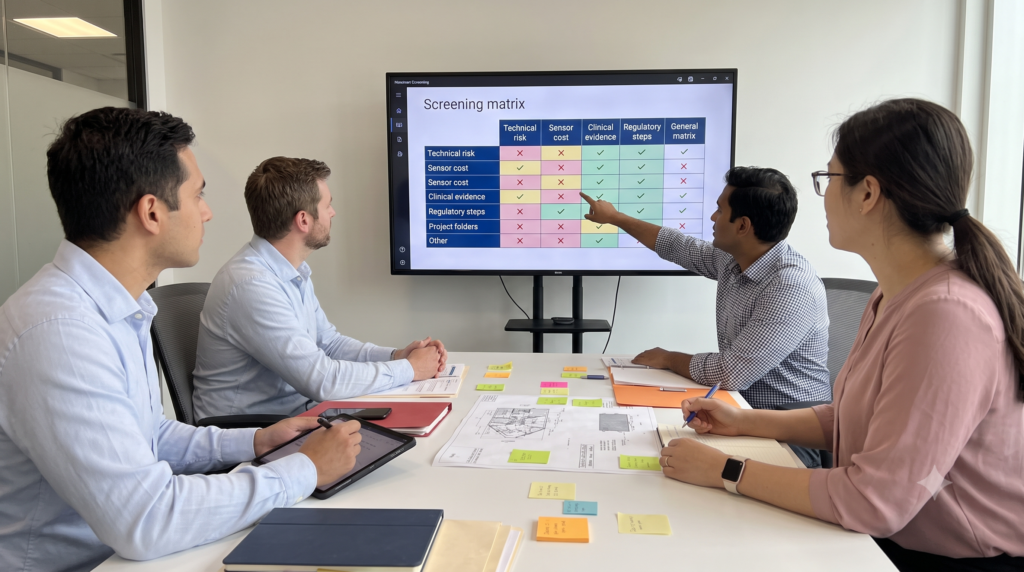
A more practical initial product could combine validated health-monitoring capabilities with an integrated health dashboard and AI-powered analysis, while advanced biochemical measurements remain longer-term development goals.
Screening helps the team decide which concept deserves further investigation instead of allowing novelty to determine the product direction.
Key question: Which opportunities offer the strongest combination of customer value, market potential, strategic fit, and practical feasibility?
3. Concept Development and Testing: Turn an Opportunity into a Testable Proposition
Once an opportunity passes initial screening, the team develops a clearer product concept. This includes defining the target audience, the problem being addressed, the proposed value proposition, the main benefits, the expected experience, and the reasons customers might choose the product over alternatives.
For a healthcare watch, concept development can include sketches, interface designs, sensor configurations, dashboard layouts, physical prototypes, and demonstrations of potential health insights. These representations help the team investigate the product’s appearance, usability, information hierarchy, and practical fit with everyday life.
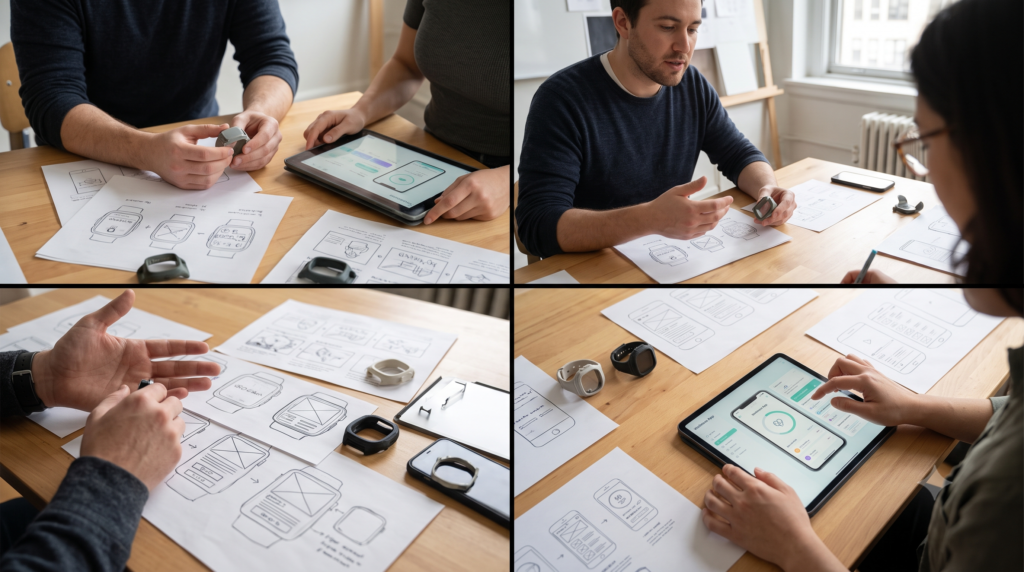
Imagine three initial concepts for the healthcare watch. The first focuses on essential health tracking and a unified dashboard. The second combines advanced physiological monitoring with personalized health-trend analysis. The third explores a future healthcare watch incorporating advanced biochemical sensing and a broader range of health indicators.
Instead of choosing the most technologically advanced option, the team tests the concepts with potential users. Customers can compare the designs, explore prototype dashboards, discuss their health-monitoring routines, and explain which features they find useful or unnecessary.
Testing may reveal that customers value reliable measurements, understandable insights, and a simple interface more than an overwhelming number of health metrics. It may also show that users need clearer explanations of changes in their health data rather than simply more notifications.
Concept testing helps teams refine the product proposition before committing to expensive engineering, sensor development, and clinical validation.
Key question: Does the proposed product concept offer a compelling solution to the problem, and is there enough evidence to develop it further?
4. Business Analysis: Determine Whether the Product Makes Business Sense
A product may be desirable to customers but still be commercially unsustainable. Business analysis examines whether the opportunity can support a viable business proposition.
This stage evaluates market size, expected demand, competitive positioning, pricing, revenue potential, development costs, manufacturing expenses, distribution, customer acquisition, support obligations, and potential returns on investment.
For advanced healthcare products, cost analysis is particularly important. The economics depend on more than the cost of the watch itself. Teams must also account for specialised sensors, research and development, software, AI infrastructure, testing, clinical validation where required, regulatory compliance, manufacturing, warranties, and ongoing support.
For the healthcare watch, the business team might compare a product built around existing health-monitoring capabilities with a more advanced version incorporating emerging biochemical sensing technologies. The advanced version could offer greater differentiation, but it would also introduce additional research, development, validation, and manufacturing costs.

The team would investigate whether intended customers are willing to pay enough for the additional benefits. It would also assess whether the proposed product can achieve an acceptable margin at realistic sales volumes.
Business analysis should not be reduced to producing optimistic financial forecasts. It should make assumptions explicit and identify the evidence needed to support them.
Key question: Can the product create sufficient customer and business value to justify the investment and ongoing costs?
5. Product Development: Build a Solution That Delivers the Promise
After the concept and business case demonstrate sufficient potential, the team moves into product development. This involves translating the product requirements and validated concept into a working product that can be manufactured consistently.
For the healthcare watch, development may involve industrial design, hardware engineering, sensor integration, software development, AI systems, scientific testing, prototyping, quality assurance, and safety validation.
Designers refine the watch’s form, comfort, display, interface, and usability. Engineers evaluate sensor performance, battery life, connectivity, durability, and hardware integration. Software teams build the health dashboard, data-processing systems, and tools that help users understand their health information.

Several prototype iterations may be necessary. An early prototype might validate the physical design and interface, while another tests sensor performance. Later prototypes can evaluate measurement reliability, AI-generated insights, usability, and production processes.
A sensor that performs well under controlled conditions may produce unreliable results during everyday use. An algorithm may misinterpret certain patterns, or the battery may not last as long as expected. Identifying these problems early allows the team to improve the product before large-scale production.
More advanced capabilities, such as non-invasive blood-biomarker monitoring, may require substantial scientific research and validation before they can become reliable product features.
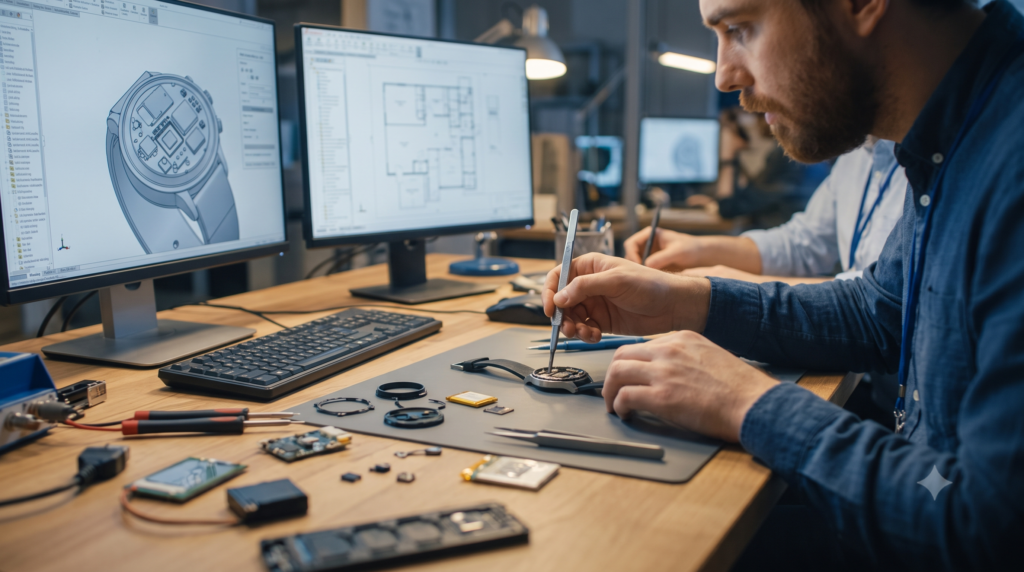
The objective is not to build every possible feature. It is to develop a product that reliably delivers the value promised to customers while meeting the required quality and safety standards.
Key question: Can we design, engineer, and develop a product that meets customer expectations and performs reliably?
6. Market Testing: Validate the Product in Real-World Conditions
A product that performs well in development may behave differently when used by real customers. Market testing evaluates the product and its commercial proposition under realistic conditions before a wider launch.
Depending on the product, this may involve user trials, pilot releases, controlled studies, beta programmes, or experiments with pricing and positioning.
For the healthcare watch, a selected group of potential customers could use an appropriately validated version during their everyday routines. The team would examine whether users find the dashboard understandable, whether the watch is comfortable to wear, how useful they find its insights, and whether the device performs reliably over time.

The team should observe actual behaviour rather than relying exclusively on positive comments. Customers may like the idea of comprehensive health monitoring but rarely use the insights. They may appreciate advanced capabilities but reject the product at its proposed price.
Market testing can expose weaknesses in the product experience, reliability, pricing, positioning, and adoption assumptions. Any medical capabilities would also require the appropriate clinical evidence and regulatory processes; consumer testing alone cannot establish diagnostic accuracy.
Key question: Do real customers use, value, and adopt the product under realistic conditions?
7. Commercialization: Bring the Product to Market
Commercialization is the stage in which the organisation prepares for and executes the broader market launch. It turns a developed and tested product into an offering that customers can discover, access, purchase, and use.
For healthcare technology, this involves finalising production, selecting manufacturing partners, establishing quality standards, securing suppliers, planning inventory, setting pricing, choosing distribution channels, and preparing marketing and customer support.
The organisation must also establish a clear product position. Is the healthcare watch a premium wellness device, a comprehensive personal health-monitoring companion, or an advanced technology platform that combines health data and AI-powered insights? The answer influences product design, pricing, messaging, distribution, and target customers.
A product that is technically excellent can struggle if its benefits are unclear, its price is poorly aligned with the target market, or customers cannot find it where they prefer to shop.
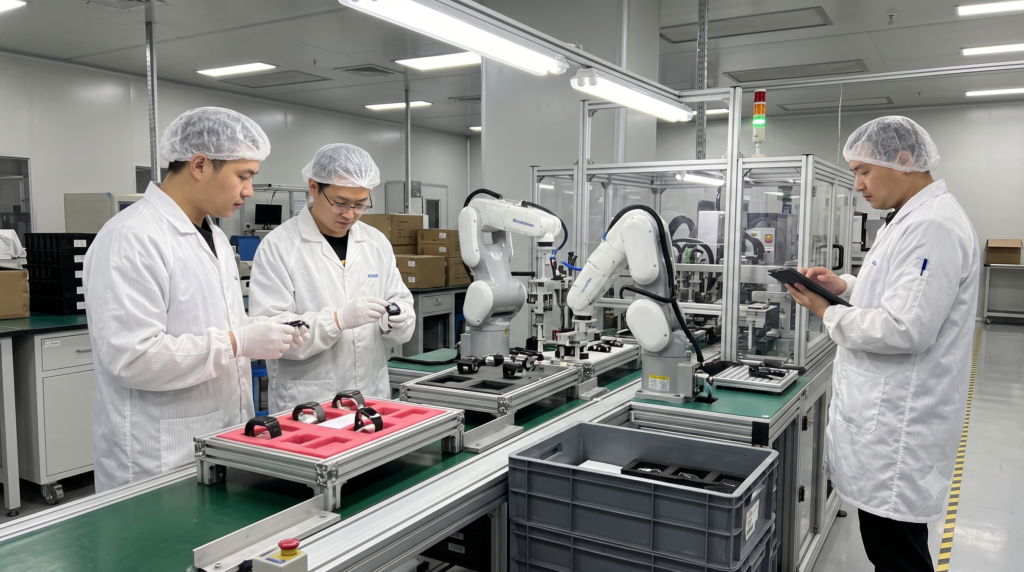
For the healthcare watch, commercialization should communicate the product’s validated capabilities and practical benefits rather than simply listing its technical features. Claims about blood biomarkers, disease detection, or medical diagnosis must be supported by appropriate evidence and authorization.
The organisation must also ensure that the supply chain can meet demand and that product quality remains consistent as production scales.
A launch is not proof of success. It marks the point at which the product’s assumptions begin to face the full complexity of the market.
Key question: How will we reach the right customers, communicate the product’s value, and deliver it effectively at scale?
8. Post-Launch Review: Learn, Improve, and Create Lasting Value
The NPD process does not end when the product reaches the market. Post-launch review examines whether the product is achieving its intended customer, market, and business outcomes.
Teams compare actual performance with the objectives established earlier. They may evaluate sales, revenue, margins, returns, product defects, customer satisfaction, repeat purchases, reviews, and the performance of different sales channels.
For the healthcare watch, post-launch learning can reveal issues that were difficult to identify during controlled testing. Customers may find the dashboard confusing, consider certain notifications unnecessary, experience battery problems, or struggle to interpret health insights. Usage data might show that people value certain monitoring features more than others, while customer feedback may reveal opportunities for better personalization.

These findings should inform decisions about product improvements, new features, pricing changes, software updates, and expansion into new markets. As scientific capabilities advance, the company might also explore additional health-monitoring features, subject to appropriate validation and regulatory requirements.
The team should assess whether the product creates the intended customer and business value. A product that sells well initially but generates poor reviews or loses users quickly may not be delivering sustainable value.
Post-launch review creates a learning loop. Customer feedback, product performance, and business results become inputs for the next cycle of innovation.
Key question: Is the product delivering the expected value, what have we learned, and what should happen next?
NPD vs. Design Thinking vs. Design Sprint
NPD, Design Thinking, and Design Sprint are related approaches, but they address different aspects of innovation. They should not be treated as interchangeable alternatives.
New Product Development is the end-to-end product journey. It connects opportunity identification, evaluation, concept development, business analysis, product creation, market testing, commercialization, and post-launch learning.
Design Thinking is a human-centred approach to understanding problems and exploring solutions. Its activities commonly include empathising with users, defining the problem, generating ideas, prototyping, and testing. It is especially useful when customer needs are unclear or a team needs to reframe a problem before committing to a solution.
Design Sprint is a time-constrained method for answering critical questions through focused collaboration, prototyping, and testing. It is useful when a team needs to evaluate a specific idea, explore a design direction, or reduce uncertainty quickly.

The distinction becomes clearer when applied to the healthcare watch. NPD guides the entire journey from identifying the healthcare opportunity to developing and launching a commercially viable product. Design Thinking helps the team understand how people manage their health information and what would make health insights more useful. A Design Sprint could then test a particular dashboard, notification experience, or way of presenting health trends.
These approaches can complement one another. A team might use Design Thinking to understand customer needs, a Design Sprint to test a specific concept, and NPD to guide the selected solution through business analysis, engineering, validation, commercialization, and post-launch improvement.
NPD provides the broader journey; Design Thinking and Design Sprint provide methods that can strengthen particular parts of that journey.
What Makes NPD Effective?
Following the eight stages does not guarantee success. The quality of decisions, the strength of evidence, and the organisation’s ability to respond to new information determine how useful the process becomes.
Effective NPD begins with a clearly defined customer or market opportunity rather than an attachment to a predetermined solution. It validates assumptions early, evaluates customer value alongside commercial viability, and involves the right functions before expensive decisions become difficult to reverse.
For complex healthcare products, it is especially important to integrate product design, sensor engineering, software, scientific validation, safety, usability, regulatory requirements, and manufacturing from the beginning. A product should not merely look appealing in a concept presentation; it must work reliably in people’s lives and meet the requirements of its intended use.

It also helps to balance structure with flexibility. A product involving advanced sensors, AI, and potential biochemical measurements may require extensive scientific research and validation. A simpler health-monitoring device may allow faster prototyping and fewer technical stages. The methods and evidence requirements should reflect the product’s complexity, risks, and intended market.
Most importantly, NPD should be guided by measurable outcomes. Instead of defining success only as completing development or launching on schedule, teams should establish what meaningful change the product is expected to create for customers and what business results would justify continued investment.
For the healthcare watch, success might involve helping users understand supported health indicators more easily, developing a reliable and comfortable wearable, achieving a commercially sustainable margin, maintaining customer trust, and improving the overall health-monitoring experience.
This shifts attention from delivering a product to delivering a product that creates value.
From Product Ideas to Business Impact
The value of New Product Development lies in connecting customer needs, market opportunities, organisational capabilities, and business objectives through a disciplined learning process.
An unsolved problem can reveal an opportunity. Idea screening determines whether it deserves attention. Concept development makes the opportunity tangible. Business analysis tests its commercial potential. Product development turns the concept into a working solution. Market testing evaluates it in real-world conditions. Commercialization brings it to customers, and post-launch review establishes whether it is delivering the intended outcomes.
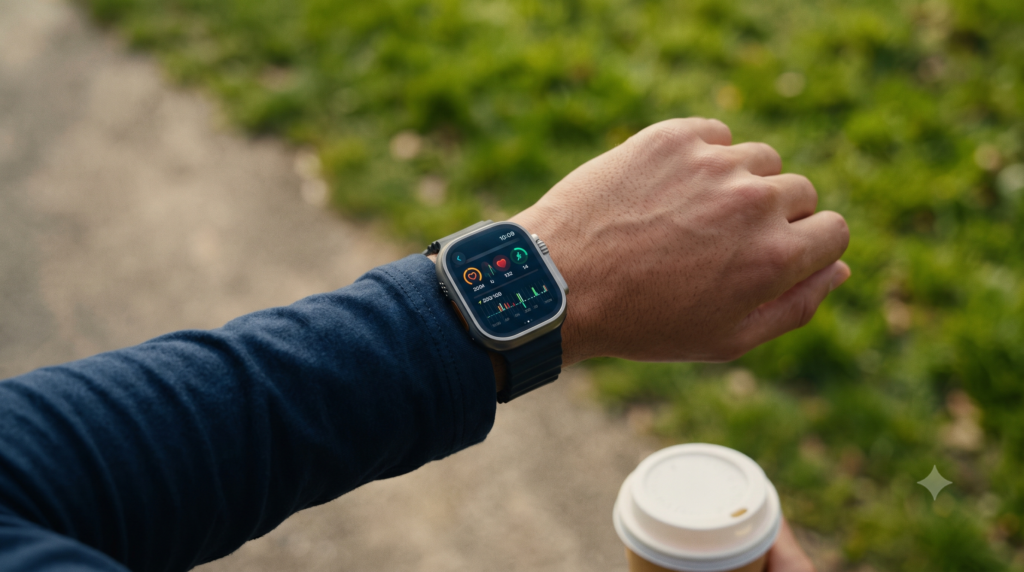
The healthcare watch illustrates why every stage matters. A meaningful idea must become a desirable concept. A desirable concept must become a technically reliable product. A well-built product must reach the right customers at the right price. And a successful launch must lead to lasting customer satisfaction and sustainable business performance.
However, NPD should not become a rigid checklist. New evidence may require teams to revisit the problem, reconsider the target market, modify the design, or stop an initiative that no longer makes sense. The purpose of structure is to improve decisions, not to prevent change.
Ultimately, successful product development is not about producing more ideas, adding more features, or launching faster at any cost. It is about identifying the right opportunities, solving problems that matter, designing products that fit people’s lives, and building offerings that can sustain a successful business.
That is the real purpose of NPD: transforming unsolved problems and market gaps into meaningful products that create business value.