

A Methodological Framework for Client-Centric Integrated Marketing Strategy Formulation for Small and Medium-Sized Enterprises.
Abstract
Small and medium-sized enterprises (SMEs) face significant challenges in developing sustainable marketing strategies due to resource constraints and reliance on fragmented, template-driven approaches. This research introduces the Design Thinking Marketing Model (DTMM), a novel methodological framework that adapts the five-stage Design Thinking process (Empathize, Define, Ideate, Prototype, Test) to marketing strategy development. Using a case study approach with qualitative research methods including in-depth interviews, client review analysis, and iterative prototyping, this study demonstrates how DTMM enables SMEs to develop client-centric, adaptive marketing strategies. The framework integrates market intelligence, brand positioning, content strategy, digital marketing, and customer engagement into a cohesive 360° approach. Findings reveal that DTMM addresses critical gaps in traditional marketing by emphasizing empathy-driven insights, continuous iteration, and personalization over generic tactics. The research validates that human-centered design principles, combined with sprint-based agile execution and strategic AI integration, create sustainable competitive advantages for resource-constrained SMEs. This study contributes a replicable, evidence-based framework applicable across industries seeking to embed innovation-driven practices into marketing management.
Introduction
Research Context:
Small and medium-sized enterprises represent a critical economic segment yet struggle disproportionately with marketing effectiveness compared to larger competitors. Traditional digital marketing approaches – including purchased leads, paid email marketing, and generic paid campaigns – increasingly fail to deliver sustainable results in competitive markets where customers demand transparency, personalization, and authentic engagement. These challenges are compounded by limited marketing budgets, absence of in-house expertise, and dependence on one-size-fits-all strategies that fail to resonate with diverse client needs.
Research Problem:
SMEs face a fundamental strategic gap: the absence of a structured, client-centric methodology for developing integrated marketing strategies that balance innovation with resource constraints. Current marketing practices emphasize tactical execution over strategic empathy, resulting in fragmented approaches that inadequately address evolving customer expectations and market dynamics. This research addresses the question: How can design thinking principles be systematically applied to create sustainable, client-centric marketing strategies for SMEs?
Research Objectives:
This study aims to:
(1) develop and validate a Design Thinking Marketing Model (DTMM) specifically adapted for SME integrated marketing strategy formulation;
(2) Demonstrate how empathy-driven, sprint-based iterative processes enhance lead quality, customer engagement, and brand credibility;
(3) Design sustainable and adaptive marketing strategies that can evolve with market dynamics and customer needs.; and
(4) provide empirical evidence for combining human intelligence with AI-driven tools to achieve cost-effective, scalable marketing solutions.
Literature Review
Design Thinking Foundations
Design Thinking has emerged as a transformative methodology for innovation and problem-solving across disciplines. Originating in design fields, it comprises five iterative phases—Empathize, Define, Ideate, Prototype, Test—that prioritize user needs and creative experimentation. The Interaction Design Foundation characterizes it as human-centered, non-linear, and collaborative, enabling organizations to reframe challenges from user perspectives
Design Thinking in Marketing
Recent literature extends Design Thinking beyond product development into marketing strategy. Ridho and Lahindah (2023) emphasize that Design Thinking-driven marketing strategies bring holistic change to product development and brand communication. By embedding empathy and creativity at the core of marketing processes, companies can develop offerings that resonate more deeply with consumer needs. Their research indicates that such strategies enhance competitiveness by differentiating products and building long-term customer relationships through engagement and trust. However, most existing research remains conceptual or sector-specific, with limited empirical validation of structured frameworks for SME application.
Furthermore, research on AI-powered marketing highlights both opportunities and risks. Aithal et al. (2022) point out that artificial intelligence allows companies to personalize experiences at scale, but without a human-centered approach, AI risks reducing consumers to mere data points. Design Thinking provides the missing framework for embedding empathy into digital tools, ensuring that AI-driven personalization remains aligned with consumer needs and values. This balance of technological efficiency and human-centered creativity creates marketing strategies that are both scalable and authentic.
Emotional Marketing and Consumer Behavior:
Emotional marketing represents another critical intersection with Design Thinking principles. Guo (2024) emphasizes that emotional marketing goes beyond functional benefits, establishing authentic connections with consumers through storytelling and sensory engagement. Campaigns such as Nike’s Just Do It illustrates how emotional resonance can enhance brand loyalty, trust, and consumer advocacy. By integrating emotional triggers into the iterative process of prototyping and testing, Design Thinking ensures that campaigns not only appeal to logic but also connect deeply with consumer emotions, shaping purchasing behavior and long-term loyalty.
Research Gap:
Despite growing recognition of Design Thinking’s value, empirical frameworks demonstrating its systematic application to integrated marketing strategy development for SMEs remain scarce. This research addresses this gap by proposing and validating DTMM – a structured, evidence-based model specifically designed for resource-constrained enterprises
Research Methodology
The research adopts a pragmatic paradigm, where the focus is on applying knowledge to solve real-world problems. It merges academic rigor with business practicality, explicitly favoring approaches that deliver actionable solutions. The Design Thinking framework is central to this methodology, intentionally chosen for its iterative, human-centered, and problem-solving orientation. By rooting the study in a design thinking context, the research gains both flexibility (with an iterative feedback loop) and depth (through empathy and actual user insight).
Data Collection:
Primary Data:
In-depth semi-structured interviews were conducted with business owners and staff to capture organizational challenges, client needs, and marketing practices. Interview guides explored current strategies, pain points, competitive pressures, and aspirations. To further enrich the analysis, insights were gathered from frontline staff members through a structured survey instrument.
Secondary Data:
Systematic analysis of client reviews from public platforms provided external validation of service perceptions, identifying recurrent themes related to trust, empathy, responsiveness, and process experiences.
Authoritative industry reports and statistical data were collected. These secondary sources provided essential context for understanding external market forces, competitive dynamics, and industry best practices that shape SME marketing strategy requirements.
Research Framework: Design Thinking Process:
The research process strictly follows the five phases of Design Thinking:
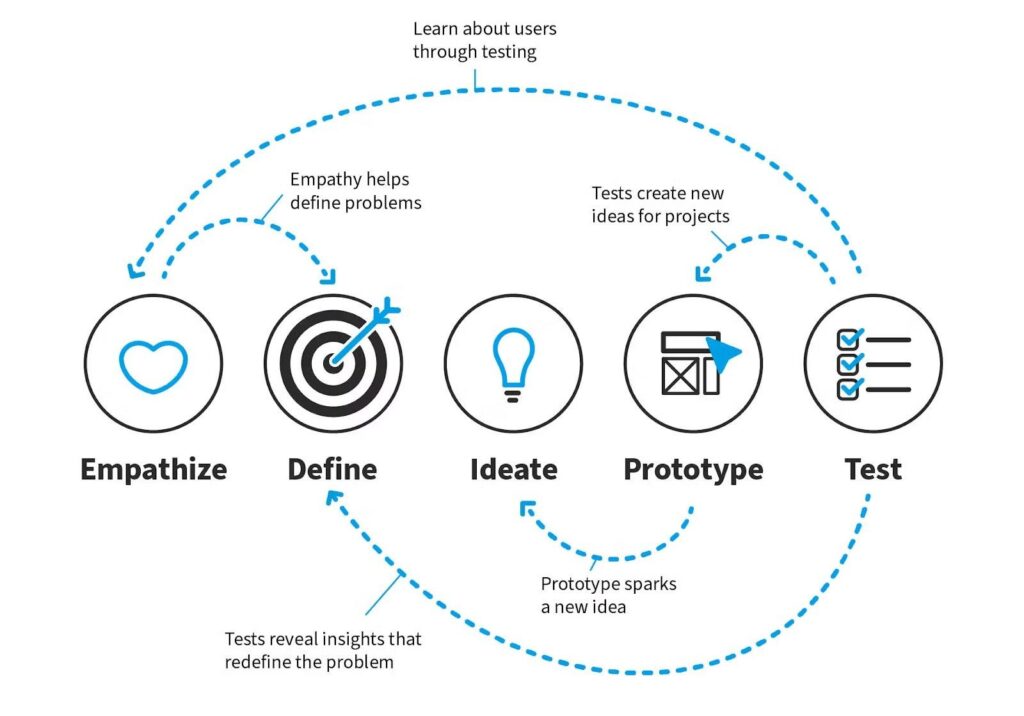
Image Source – Interaction Design Foundation – Design Thinking Process
- Empathize: Developed empathy maps, user personas, and customer journey maps to understand stakeholder experiences comprehensively. Review mining and thematic coding revealed emotional drivers and unmet needs.
- Define: Applied the 5W framework (Who, What, Where, When, Why) to articulate problems clearly. Created User Journey Map, Problem Statements, Point of View (POV) statements and How Might We (HMW) questions to frame challenges as innovation opportunities.
- Ideate: Conducted collaborative brainstorming sessions using techniques including Crazy 8s, mind mapping, and dot voting to generate diverse solutions. Developed integrated marketing roadmaps encompassing market research, branding, content, digital channels, and engagement strategies.
- Prototype: Created low-fidelity mockups (email templates, content outlines, wireframes) and high-fidelity prototypes (campaign designs, landing pages) for rapid testing. Implemented pilot initiatives using sprint-based execution to enable iterative refinement.
- Test: Gathered feedback through surveys, interviews, and digital engagement metrics. Benchmarked outcomes against historical data to quantify impact and guide continuous iteration.
Data Analysis:
Thematic content analysis was applied to interview transcripts and reviews, coding for emergent themes including empathy, trust, process efficiency, and competitive differentiation. Comparative metrics assessed lead quality, engagement scores, and conversion rates where applicable. Journey mapping and empathy maps provided visual syntheses of user experiences and opportunity areas.
Reliability and Validity:
Triangulation across multiple data sources (interviews, reviews, industry benchmarks) ensured reliability. Structured protocols minimized bias, and findings were validated through iterative stakeholder feedback. Transparent documentation of all analytical steps supports reproducibility.
Results and Analysis
The Design Thinking Marketing Model (DTMM) application across five phases produces comprehensive insights that transform qualitative understanding into actionable marketing strategies.
The Empathize phase reveals organizational strengths (relational capabilities, domain expertise) alongside critical gaps (marketing infrastructure, digital visibility, systematic retention mechanisms), typically uncovering a significant disconnect between service quality and market presence.
The Define phase synthesizes these insights using structured frameworks (5W Analysis, POV statements, HMW questions) to reframe challenges as strategic opportunities across multiple domains including market intelligence, branding, content strategy, digital/social media marketing, email marketing, contextual advertising, acquisition strategy, AI integration and customer experience enhancement.
The Ideate phase generates diverse solutions categorized by implementation feasibility – quick wins requiring minimal resources, foundational initiatives requiring sustained development, and aspirational innovations for future exploration – enabling organizations to balance immediate impact with long-term capability building.
Implementation or Testing phase utilization begins by selecting 3-5 quick-win initiatives that demonstrate immediate value while simultaneously establishing foundational infrastructure (content calendars, customer journey maps, performance metrics) supporting long-term strategy execution.
Organizations should adopt sprint-based cycles of 2-4 weeks where small-scale pilots test hypotheses with limited audiences and budgets before scaling successful approaches.
Iterative refinement operates through continuous measurement of both quantitative indicators (lead quality, conversion rates, engagement metrics, acquisition costs) and qualitative feedback (customer responses, stakeholder input, competitive positioning) to identify what works and why.
Each iteration cycle – implement, measure, analyze, adjust – builds organizational learning while progressively improving performance. This systematic approach validates that human-centered marketing strategies consistently outperform traditional promotional tactics when organizations commit to customer-centric thinking, evidence-based decision-making, and continuous adaptation based on real-world results rather than assumptions.
Findings, Suggestions & Conclusions
The Design Thinking Marketing Model (DTMM):
This research establishes DTMM as a structured, replicable framework for SME marketing strategy development. DTMM’s core contribution lies in systematically embedding empathy, iteration, and client-centricity into marketing processes traditionally dominated by efficiency-focused, template-driven approaches. By adapting Design Thinking’s five stages to marketing contexts, DTMM enables resource-constrained enterprises to compete effectively against larger competitors through differentiated, human-centered strategies.
Theoretical and Academic Contributions:
This research extends the application of Design Thinking beyond its traditional role in product and service innovation into the domain of marketing strategy. By proposing and testing a Design Thinking Marketing Model (DTMM), it introduces a structured, evidence-based framework for integrating empathy, creativity, and iterative testing into marketing research. This contributes to scholarly literature by offering a new lens through which small and medium-sized enterprises (SMEs) can develop client-centric marketing practices, bridging a gap between innovation theory and marketing management.
Industry and Practical Implications:
The Design Thinking Marketing Model (DTMM) provides a replicable systematic framework that SMEs across diverse industries can adopt to design more effective, low-cost, and client-focused marketing strategies regardless of their specific sector. The framework’s industry-agnostic nature stems from its foundation in universal human-centered design principles – empathy, problem definition, creative ideation, rapid prototyping, and iterative testing – which transcend sector-specific tactical differences.
The research demonstrates how low-cost, human-centered strategies emphasizing empathy, creativity, and iterative experimentation can be leveraged to address real-world marketing challenges common across competitive markets.
Conclusions
This research introduces the Design Thinking Marketing Model (DTMM) as a novel, evidence-based framework enabling SMEs to develop client-centric, integrated marketing strategies. By systematically applying empathy-driven insights, iterative prototyping, and human-AI collaboration, DTMM addresses critical gaps in traditional marketing approaches that fail to deliver sustainable results for resource-constrained enterprises.
The study validates that embedding Design Thinking principles into marketing processes enhances lead quality, customer engagement, brand credibility, and competitive differentiation. DTMM’s structured methodology – progressing through empathize, define, ideate, prototype, and test stages – provides SMEs with actionable tools for transforming fragmented tactics into cohesive, adaptive strategies aligned with evolving customer needs.
Beyond immediate practical value, this research contributes theoretically by bridging innovation frameworks and marketing management, offering a replicable model applicable across industries seeking to embed human-centered, innovation-driven practices into strategic planning. As markets increasingly demand authenticity and personalization, DTMM positions SMEs to compete effectively by leveraging empathy and creativity as strategic advantages rather than resource disadvantages.
References
IDEO U. (n.d.). Design thinking process. IDEO.
Interaction Design Foundation. (n.d.). What is design thinking and why is it so popular?
American Marketing Association. (2024, December 17). Marketing automation strategy guide.
Kotler, P. (2024, March 12). A lifetime in marketing: Lessons learned and the way ahead. American Marketing Association.
Search Engine Journal. (2024). Consumer trust and perception of AI in marketing.
Stanford d.school. (n.d.). Design thinking bootleg.
Search Engine Journal. (2024). Generative AI & social media: Redefining content creation.
Liedtka, J. (2018, September). Why design thinking works. Harvard Business Review.
ResearchGate. (2025). A literature study of marketing strategies in product development using design thinking methods.
ResearchGate. (2024). Marketing agility: A critical review of literature.
ResearchGate. (2024). Quantum marketing: A new paradigm to revolutionize the marketing strategy awareness of Indian consumers.
ResearchGate. (2023). Problem solving of digital marketing with design thinking model.
IDEO U. (n.d.). An overview of our best design thinking strategy frameworks. IDEO.
SciSpace. (n.d.). Design thinking for strategizing: A critical literature review