

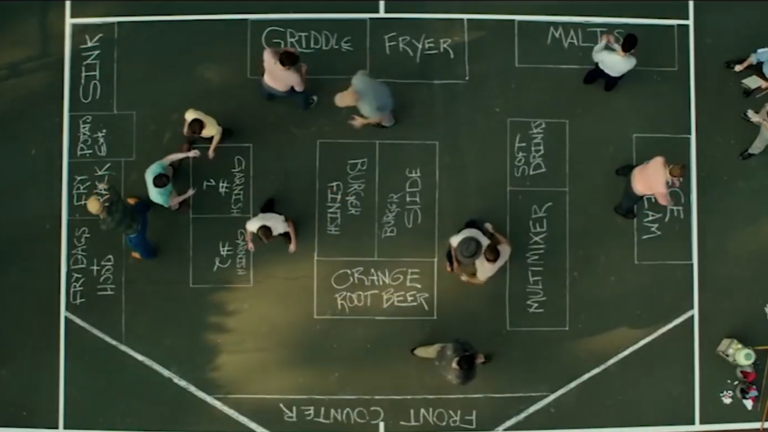
The 2016 film “The Founder” offers one of cinema’s most compelling demonstrations of design thinking in action. In a pivotal scene, brothers Dick and Mac McDonald revolutionize the fast-food industry by developing their legendary “Speedee Service System” through a methodical, user-centered approach that perfectly embodies the five stages of design thinking. This tennis court experiment wasn’t just creative problem-solving – it was a masterclass in human-centered innovation that would transform an entire industry.
The Design Thinking Masterclass Hidden in McDonald’s “Speedy System”
Long before “design thinking” became a buzzword, Dick and Mac McDonald were practicing it in its purest form.
The Problem: Speed vs. Quality in 1940s America
In the 1940s, the McDonald brothers operated a traditional drive-in restaurant in San Bernardino, California, facing frustrations typical of the era: slow service, inconsistent quality, and operational chaos. Customers waited 20-30 minutes for their orders, employees struggled with inefficient workflows, and the brothers knew their carhop model wasn’t sustainable. They recognized that the traditional drive-in format fundamentally failed to meet customer needs for speed, consistency, and affordability – setting the stage for radical innovation.
1. Empathize: Understanding Customer Pain Points
The McDonald brothers began with deep empathy for their customers’ experiences. They observed how customers grew frustrated with long wait times, observed employees struggling with complex menu items and custom orders, and understood that post-war American families wanted quick, affordable meals without sacrificing quality. This empathy phase revealed a critical insight: customers valued speed and consistency over customization, challenging the prevailing assumption that variety equaled value.
2. Define: Articulating the Design Challenge
After gathering insights, the brothers clearly defined their problem statement: “How might we deliver high-quality food to customers in 30 seconds or less while maintaining consistency and affordability?”. This definition focused their innovation efforts on three non-negotiables: reducing service time from 20 minutes to 30 seconds, ensuring every product looked and tasted identical every time, and maintaining profitability through operational efficiency. They made the bold decision to simplify their menu from 25 items to just hamburgers, cheeseburgers, fries, drinks, and pie.
3. Ideate: The Tennis Court Innovation Lab
Here’s where the magic happened – and where the film captures design thinking’s essence most brilliantly. The McDonald brothers rented a tennis court and brought their entire kitchen staff along with chalk to create a full-scale, life-sized prototype. They drew the exact dimensions of their kitchen on the court using chalk, sketched in prep stations, grills, assembly areas, and serving windows, then had employees physically act out the food preparation process while they observed and timed each movement.
Over six hours, they iterated relentlessly. They redrew layouts, repositioned equipment, reassigned tasks, and watched employees walk through the motions repeatedly. This ideation process generated dozens of layout variations, each tested in real-time with actual staff performing simulated tasks.
4. Prototype: From Chalk to Reality
The tennis court experiment embodied prototyping at its finest – cheap, fast, and iterative. Rather than investing thousands in rearranging actual kitchen equipment, the brothers used chalk drawings that could be erased and redrawn in minutes. This wasn’t theoretical planning confined to blueprints – it was rapid prototyping with real people in real motion.
Staff members became living prototypes, physically embodying different workflow configurations as the brothers observed, timed, and refined. They tested specific elements with scientific precision: cooking temperatures and times for consistently perfect fries, exact ingredient portions (six pickle slices per hamburger), optimal distances between stations to eliminate wasted steps, and assembly-line specialization where each employee mastered one task.
For six hours, they experimented relentlessly. They drew, tested, erased, and redrew kitchen arrangements, eliminated unnecessary movements, and redesigned handoffs until every second was optimized. Employees bumped into each other – they redrew. Tasks duplicated – they reassigned. Motion wasted – they repositioned. This hands-on experimentation allowed them to fail fast, learn immediately, and improve continuously without expensive consequences.
The prototype phase revealed what Richard McDonald called “a symphony of efficiency, not a wasted motion” a kitchen layout where burgers flowed seamlessly from grill to bun to assembly to customer, each step perfectly choreographed. The chalk lines on that tennis court became the blueprint for an industry revolution.
5. Test: Validating with Real Operations
After finalizing their tennis court design, the brothers rebuilt their physical kitchen to match the chalk specifications exactly. This represents design thinking’s critical testing phase, where prototypes are validated with real users in actual conditions.
They launched the Speedee System with real customers, measuring service times with stopwatches and gathering immediate feedback on every interaction. The results weren’t just improvements – they were revolutionary. Orders that once took 20-30 minutes now arrived in 30 seconds, a 60x speed improvement. Every burger looked and tasted identical through standardized procedures, eliminating the quality inconsistencies that plagued traditional drive-ins. Operational costs plummeted, enabling 15-cent hamburgers that undercut competitors while maintaining profitability. The entire customer experience transformed – speed and consistency replaced customization as the primary value drivers.
The system functioned like a factory assembly line – efficient, predictable, and crucially, scalable. But this wasn’t dehumanizing automation; it was designed around people. Customers received faster service without sacrificing quality, and employees gained clearer, more manageable roles with specialized tasks instead of chaotic multitasking.
The Design Thinking Legacy
What makes the Speedee System such a perfect design thinking case study is how it demonstrates every principle of the methodology:
- Human-centered focus: Every decision stemmed from understanding customer needs for speed and consistency
- Rapid, low-cost prototyping: The tennis court experiment cost virtually nothing compared to reconfiguring an actual kitchen
- Iterative refinement: Six hours of continuous testing and improvement rather than seeking perfection on the first try
- Cross-functional collaboration: Kitchen staff participated directly in the design process, bringing frontline insights
- Bias toward action: Rather than theoretical planning, they physically tested ideas in motion
Why This Scene Matters for Modern Innovators
The tennis court sequence in “The Founder” offers inspiration for anyone tackling complex problems. The brothers showed that breakthrough innovation doesn’t require massive budgets or advanced technology – just chalk, a tennis court, and willingness to test ideas. They proved that observing actual behavior beats theoretical planning every time, demonstrating that constraints (simplified menu) can drive creativity rather than limit it.
Perhaps most importantly, they understood that design thinking is messy, iterative, and requires letting go of ego to embrace experimentation. The brothers weren’t afraid to look foolish drawing kitchens in chalk or having employees mime making burgers – they prioritized learning over appearing expert.
From Tennis Court to Global Empire
The Speedee System became the foundation for McDonald’s transformation from a single restaurant to a global phenomenon. When Ray Kroc discovered the brothers’ operation in 1954, he immediately recognized that their design thinking process had created something scalable and repeatable. The standardized procedures, efficient layout, and assembly-line approach could be franchised and replicated worldwide while maintaining consistency.
Today, McDonald’s serves billions annually in over 100 countries, all built on the design thinking principles those two brothers tested on a tennis court in 1940s California. Their user-centered innovation didn’t just create a successful business – it invented an entirely new category of dining experience called “fast food”.
Applying These Lessons to Your Challenges
Whether you’re designing software, reimagining business processes, or solving organizational challenges, the Speedee System with Design Thinking offers a blueprint:
- Start with deep empathy for the people you’re serving
- Clearly define the specific problem before jumping to solutions
- Generate multiple ideas through collaborative brainstorming
- Build quick, cheap prototypes to test assumptions
- Observe real behavior and iterate based on what you learn
- Embrace constraints as creative fuel rather than limitations
- Involve frontline workers who understand operational realities
The tennis court wasn’t just a clever filming location – it represented a philosophy that human-centered design, rapid experimentation, and relentless iteration can transform industries. The next time you face a complex challenge, remember the McDonald brothers with their chalk and stopwatch, redesigning an industry one tennis court drawing at a time.