

In a world flooded with ideas, startups, AI tools, and rapid experimentation, one truth remains constant:
Most innovation fails not because of bad solutions — but because of poorly defined problems.
Modern frameworks like Design Thinking, Lean Startup, and Agile have improved how we build solutions. But they often move too quickly into ideation and prototyping without fully validating the deeper structure of the problem.
That is where DHARMA CODE™ emerges as a next-generation innovation framework.
It is not just a creative method. It is an innovation framework.
What Is DHARMA CODE ?
DHARMA CODE™ is a structured, human-centered, strategic framework designed for:
- Problem Solving
- Research & Development
- Product Innovation
- Policy Design
- Organizational Transformation
- AI & Technology Development
It integrates clarity, systems thinking, long-term value alignment, strategic resolution, risk modeling, and adaptive execution into one continuous improvement loop.
Unlike traditional models, DHARMA CODE™ ensures:
✔ You solve the right problem
✔ You understand the full system
✔ You create sustainable value
✔ You reduce risk before scaling
✔ You execute with discipline
The framework operates as a circular, iterative loop:
Discover → Hear → Align → Resolve → Model → Act → Repeat
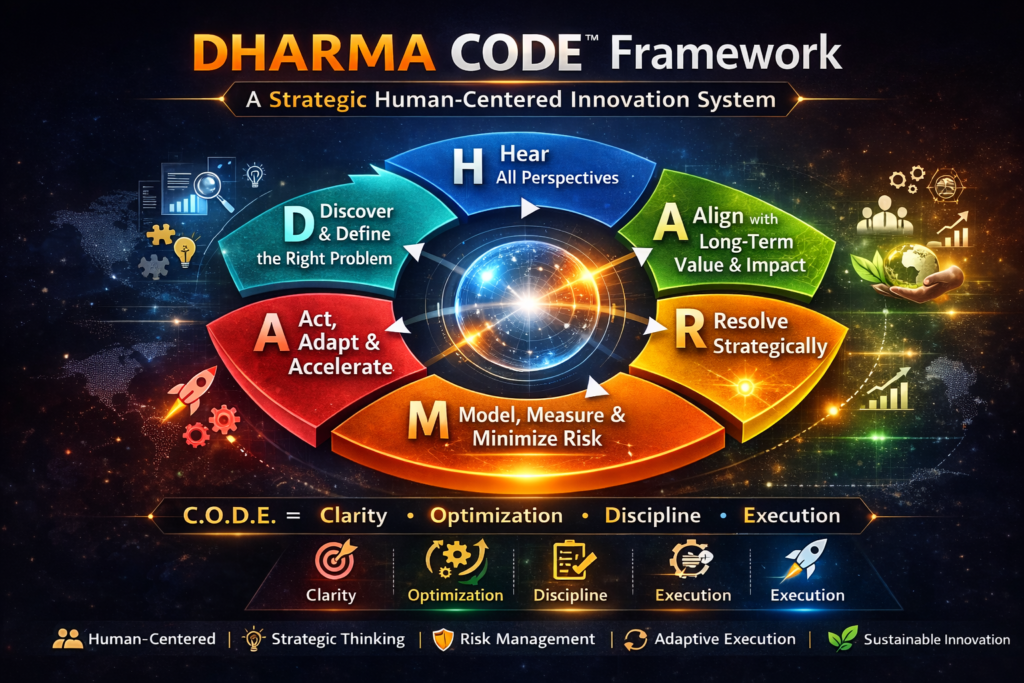
D – Discover & Define the Right Problem
Most innovation collapses here.
Teams often:
- Solve what is visible, not what is structural
- Follow trends instead of evidence
- Confuse symptoms with root causes
This stage ensures precision.
Key Focus:
- User research
- Data validation
- Root cause analysis
- Problem reframing
Core Question:
Are we solving a validated, high-impact, root-level problem?
When this stage is done correctly, solution quality improves exponentially.
H – Hear All Perspectives
Innovation does not happen in isolation.
Every problem exists inside a system:
- Users
- Stakeholders
- Regulators
- Competitors
- Market forces
- Technology constraints
This stage expands thinking beyond empathy to ecosystem awareness.
Key Focus:
- Stakeholder mapping
- Incentive analysis
- System feedback loops
- Environmental constraints
You are not designing a product.
You are intervening in a living system.
A – Align with Long-Term Value & Impact
Fast innovation without foresight creates long-term damage.
This stage ensures your solution is:
- Sustainable
- Responsible
- Trust-preserving
- Strategically aligned
Core Question:
Does this create durable value without unintended harm?
This filter prevents short-term gains at long-term cost.
R – Resolve Strategically
Now creativity becomes structured power.
Instead of random brainstorming, this stage focuses on:
- Strategic positioning
- Contradiction resolution
- Trade-off analysis
- Competitive advantage
Solutions are not just creative — they are leverage-driven.
This is where differentiation happens.
M – Model, Measure & Minimize Risk
Most innovation fails during scaling.
This stage reduces uncertainty before full commitment.
Key Focus:
- Prototyping
- Simulation
- A/B testing
- Cost-benefit modeling
- KPI tracking
You test before you invest heavily.
Risk becomes managed — not guessed.
A – Act, Adapt & Accelerate
Execution without feedback is blind.
This stage ensures:
- Agile implementation
- Continuous measurement
- Iterative refinement
- Scalable growth
After execution, insights feed back into the first stage.
DHARMA CODE is not linear. It is evolutionary.
In DHARMA CODE:
C.O.D.E. = Clarity • Optimization • Discipline • Execution
C — Clarity
Define the right problem with evidence, depth, and precision.
O — Optimization
Design solutions that maximize impact while minimizing waste and unintended harm.
D – Discipline
Apply structured thinking, strategic modeling, and risk awareness.
E — Execution
Implement decisively, learn continuously, and scale responsibly.
Together, DHARMA and CODE transform innovation from inspiration into systemized intelligence.
DHARMA CODE is a universal innovation framework that integrates validated problem discovery, multi-perspective system intelligence, long-term value alignment, strategic resolution, disciplined risk modeling, and adaptive execution into a continuous improvement loop.