
Every day, people solve problems in different aspects of life. Whether organizing daily tasks, planning a project, managing a business, or developing technology, humans constantly analyze situations and find ways to improve them. Often, we naturally break big problems into smaller parts, identify similarities, and follow a series of steps to reach a solution. This natural approach to solving problems reflects the concept of computational thinking.
Although the term may sound technical, computational thinking is fundamentally a human-centered problem-solving method. It focuses on how people understand complex problems, simplify them, and design structured solutions that can be implemented effectively. In today’s digital world – where technology, data, and automation influence nearly every industry—computational thinking has become an essential skill for students, professionals, and innovators.
What is Computational Thinking?
Computational thinking is a problem-solving approach that involves breaking down complex problems, recognizing patterns, abstracting information, and designing step-by-step algorithms to find efficient solutions. This approach allows individuals to analyze problems logically and develop clear, structured solutions.
The concept gained global attention through the work of computer scientist Jeannette Wing, who emphasized that computational thinking should be considered a fundamental skill for everyone, not just programmers or computer scientists. It encourages logical reasoning, systematic thinking, and creativity when solving problems.
In simple terms, computational thinking helps people understand problems better and create smarter solutions.
Core Steps of Computational Thinking
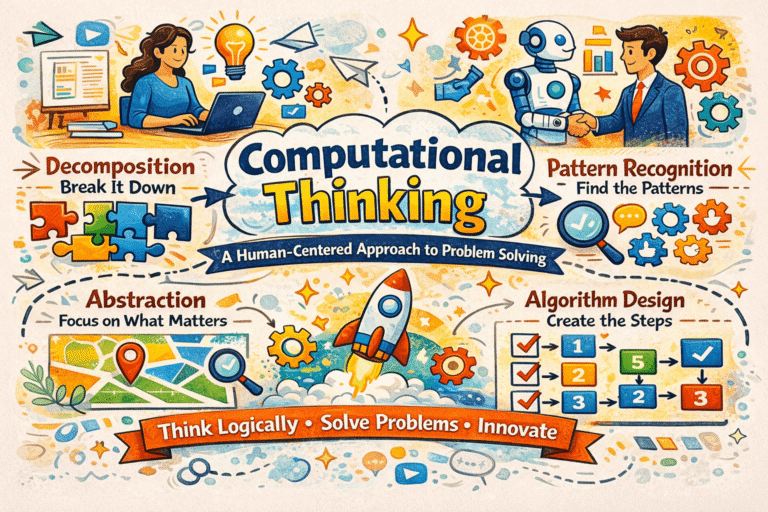
Computational thinking follows a structured process that typically includes four key steps. These steps help transform complex problems into clear and practical solutions.
1. Decomposition
Decomposition is the process of breaking a complex problem into smaller and more manageable parts. Large challenges can often feel overwhelming, but dividing them into smaller tasks makes them easier to understand and solve.
For example, when building a website, the project can be divided into tasks such as designing the interface, creating content, writing code, testing the functionality, and launching the final product. By focusing on each smaller component individually, the overall project becomes easier to manage and execute.
2. Pattern Recognition
Pattern recognition involves identifying similarities, trends, or repeated structures within problems or data. Recognizing patterns allows individuals to apply previous solutions to similar problems, making problem-solving more efficient.
For example, businesses analyze customer purchasing patterns to understand consumer behavior, while programmers identify recurring structures in code when developing applications. Detecting patterns helps reduce complexity and improves efficiency.
3. Abstraction
Abstraction focuses on simplifying a problem by concentrating only on the important details while ignoring unnecessary information. This step reduces complexity and allows individuals to focus on the elements that directly influence the solution.
A simple example of abstraction can be seen in maps. A map does not show every object in a city but highlights essential elements such as roads, landmarks, and directions. Similarly, abstraction helps create simplified models that make complex systems easier to understand.
4. Algorithm Design
Algorithm design involves creating a sequence of step-by-step instructions that guide the solution of a problem. An algorithm ensures that tasks are performed logically and efficiently.
For example, making a cup of tea can follow a simple algorithm: boil water, add tea leaves, mix sugar and milk, stir, and serve. In technological fields such as Artificial Intelligence and Data Science, algorithms are essential for analyzing data, automating tasks, and enabling intelligent systems.
Use of Computational Thinking in Artificial Intelligence
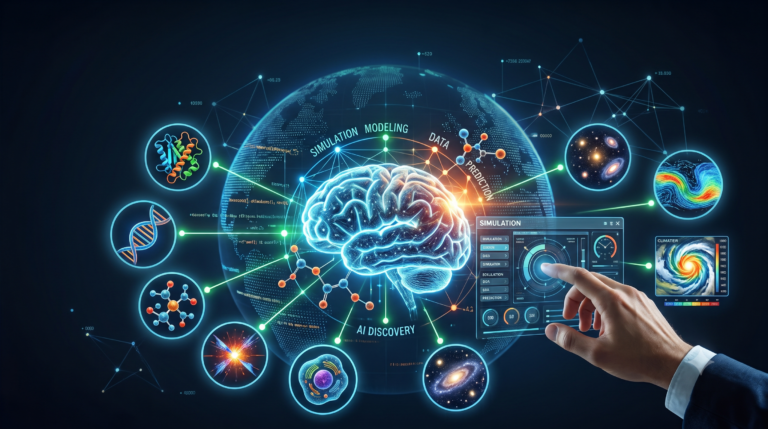
Computational thinking plays a crucial role in the development and functioning of artificial intelligence systems. AI technologies rely heavily on structured problem-solving methods to process data, recognize patterns, and make intelligent decisions.
For example, machine learning models analyze large datasets to detect patterns and trends. This process involves decomposition to divide complex tasks, pattern recognition to identify relationships in data, abstraction to focus on relevant features, and algorithm design to train models that can make predictions or decisions. Without computational thinking principles, it would be difficult to design systems capable of learning from data and performing intelligent tasks.
As AI continues to transform industries such as healthcare, finance, transportation, and education, computational thinking provides the foundation for building smarter and more efficient technologies.
Importance of Computational Thinking
Computational thinking has become one of the most important cognitive skills in the modern world. It improves problem-solving abilities by encouraging individuals to approach challenges logically and systematically. By breaking problems into smaller parts, people can analyze them more effectively and develop efficient solutions.
Another major benefit is that computational thinking strengthens analytical and critical thinking skills. It helps individuals evaluate information carefully, identify patterns, and make well-informed decisions. These abilities are valuable across many professions and industries.
Computational thinking also drives innovation and technological development. Many modern technologies – including artificial intelligence, automation, and data analytics – depend on structured problem-solving approaches. As digital transformation continues to reshape industries, computational thinking enables individuals to adapt and innovate.
Additionally, computational thinking is not limited to computer science. It is widely applied in fields such as business, engineering, healthcare, education, and scientific research. Professionals use computational thinking to design systems, analyze trends, optimize processes, and solve real-world challenges.
Computational Thinking in Modern Education
The importance of computational thinking is increasingly recognized in modern education systems. Recently, the Central Board of Secondary Education introduced an initiative to integrate computational thinking and artificial intelligence learning into school education. In April 2026, Union Education Minister Dharmendra Pradhan launched a Computational Thinking and Artificial Intelligence curriculum for students from Classes 3 to 8. The program aims to develop logical reasoning, digital literacy, and structured problem-solving skills among students from an early age. By introducing these concepts through practical and activity-based learning, the initiative prepares young learners for a future shaped by technology and innovation.
Real-World Applications of Computational Thinking
Computational thinking is used in many real-life situations. People apply its principles when planning projects, organizing workflows, analyzing business strategies, designing software systems, and solving scientific problems. Even simple activities such as budgeting finances, planning schedules, or preparing recipes involve elements of computational thinking.
Because it focuses on logical reasoning and structured solutions, computational thinking helps individuals approach challenges more effectively and creatively.
Conclusion
Computational thinking is more than a technical concept; it is a powerful human-centered method for solving problems in a structured and efficient way. By breaking down complex problems, recognizing patterns, abstracting key information, and designing step-by-step algorithms, individuals can develop effective solutions to difficult challenges.
As technology continues to shape modern society, computational thinking will remain a fundamental skill for innovation, creativity, and informed decision-making. By developing this mindset, people can better understand complex systems and build smarter solutions for the future.
Ultimately, computational thinking does not teach us to think like computers—it teaches us to think more clearly and solve problems more intelligently as humans.